Mika Cotton
Interview by Zeenat Wilkinson
On growing up around art
You grew up with art at the centre of family life. What do you remember about it? What do you remember about your dad’s studio? Would you also be able to share your formal training and education here?
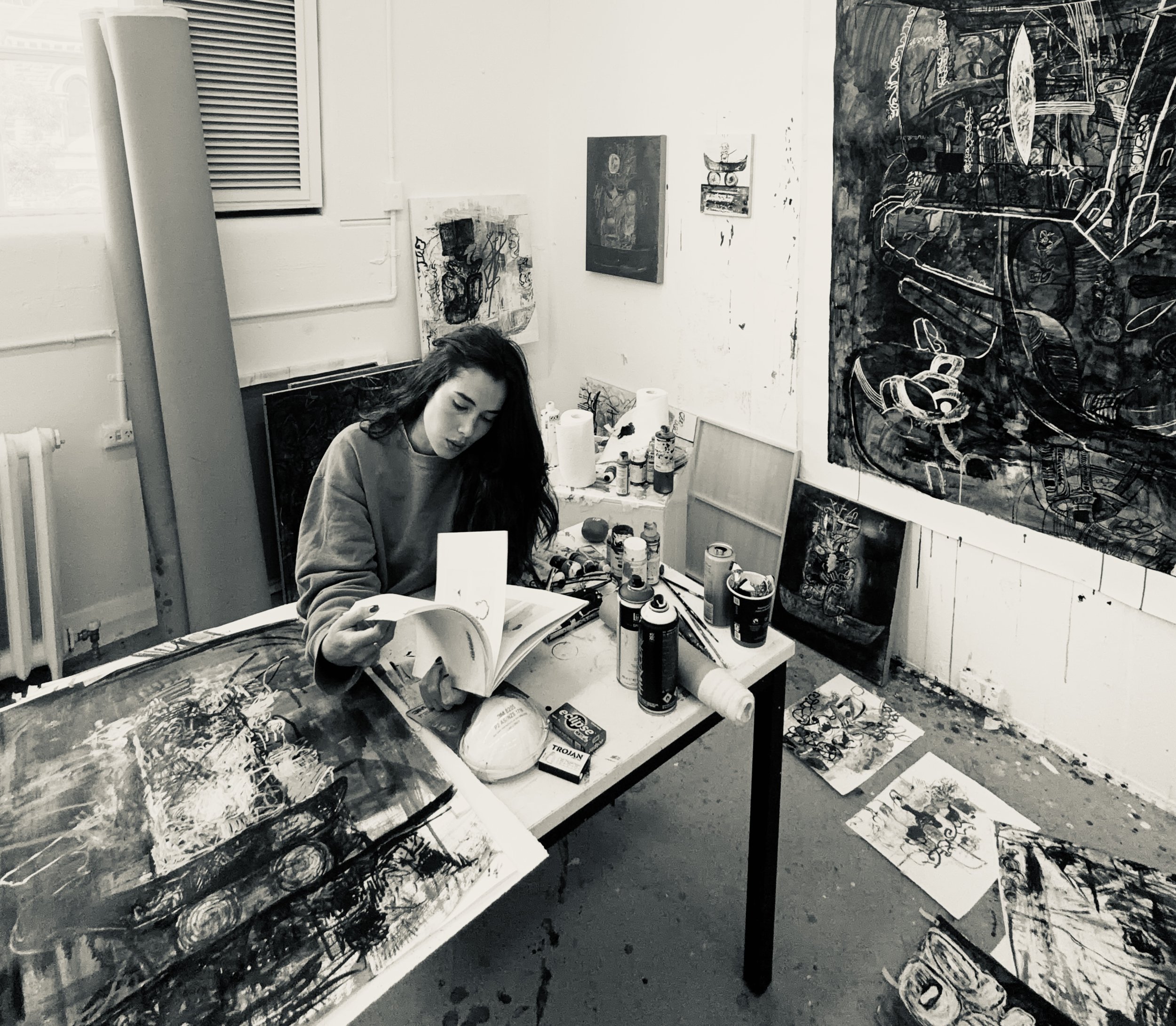
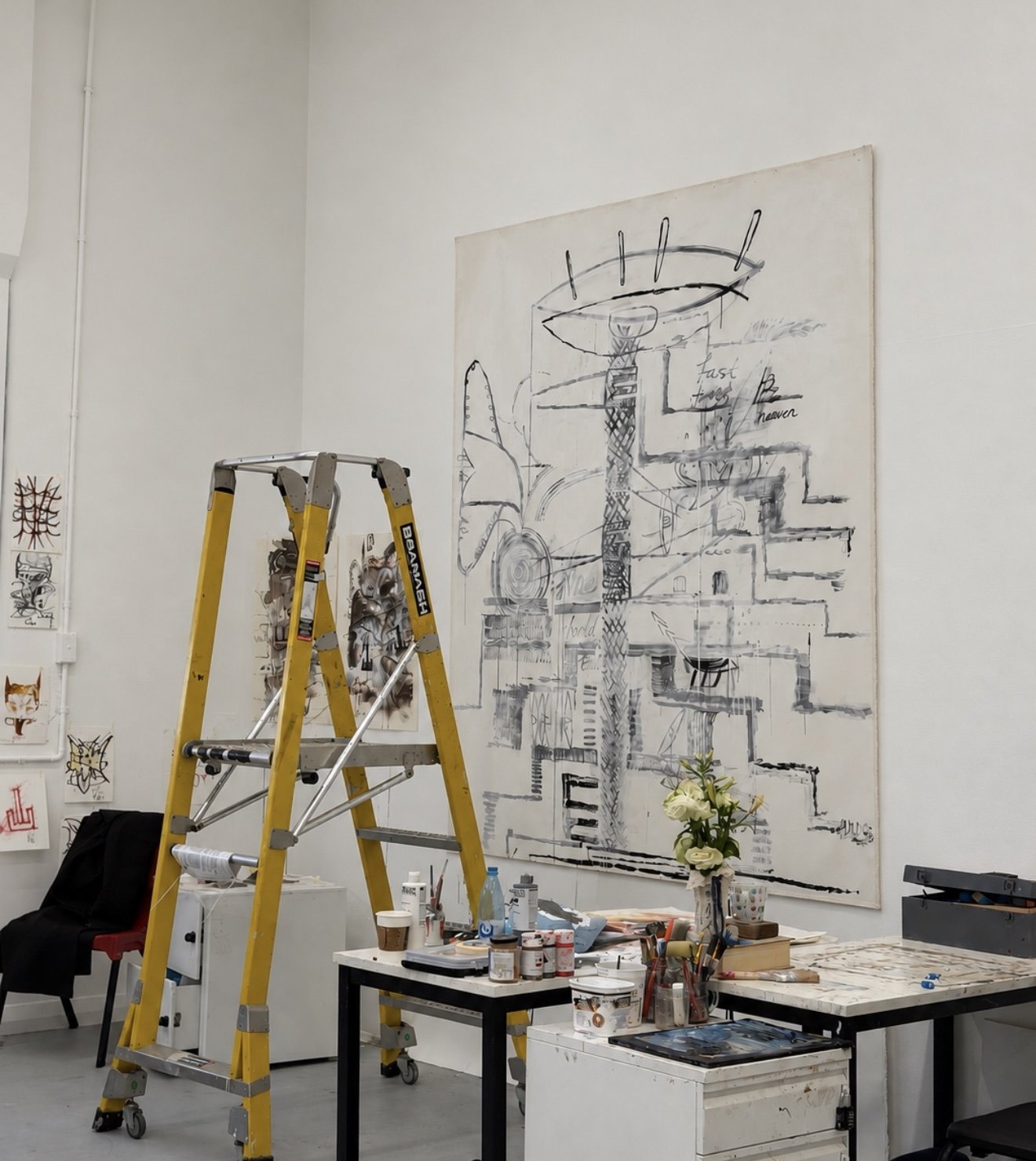
Dad’s studio was always full of objects and strange little things. I loved going there because there was so much to look at and play with. He had a drum kit, a life-size Ronnie van Hout sculpture, art everywhere, paints, brushes, books, posters, flags, PlayStation, clothes, CDs. He never seemed to throw anything away.
When he was working, he’d blast music really loudly, JAY-Z, Alicia Keys, Kendrick Lamar, Nelly Furtado, a lot of American hip-hop and R&B. I think that time shaped my music taste, and now I never paint in silence.
Looking back, I think being surrounded by so much visual information taught me to look before I even realised that was something you could learn. There wasn’t really a hierarchy between things either. A painting could be sitting beside a keychain, a piece of clothing or some strange object he had kept, and as a kid they all felt equally interesting.
I think a lot of my affection for imagery, colour and collecting probably comes from that environment. I’m still very sentimental about things and interested in the way they gather meaning over time. I absorbed a lot of that from Dad’s studio without really knowing it.
My formal education actually took a bit of a different path. I studied law at Victoria University of Wellington for five years and completed my LLB before moving to Melbourne to study a Bachelor of Fine Arts in Painting at RMIT. In some ways I’m glad I came to art school a little later. By the time I started studying painting formally, I knew it was something I wanted to take seriously and build my life around.
On the family archive
Are there things from your childhood that you find yourself returning to in your work?
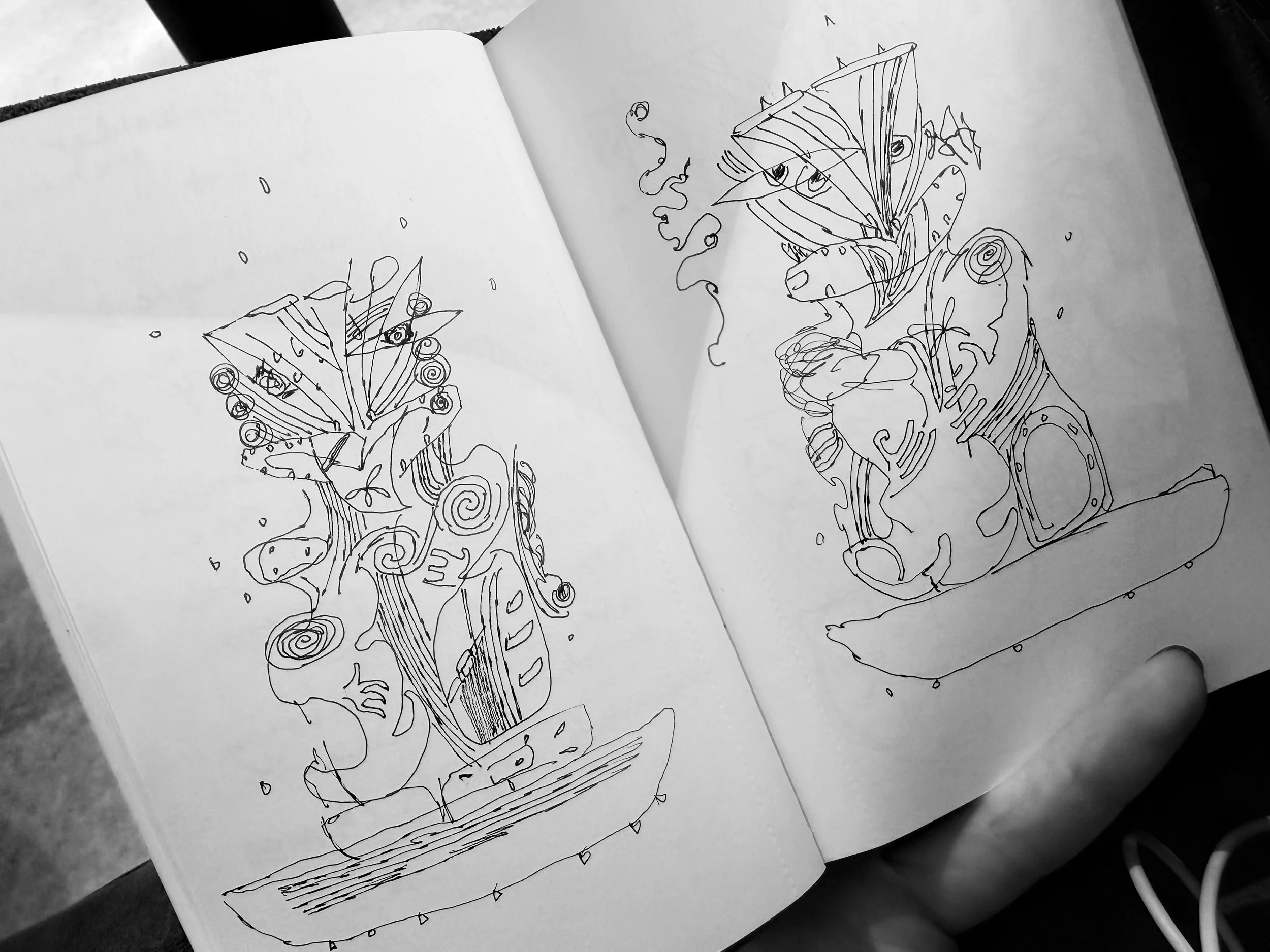
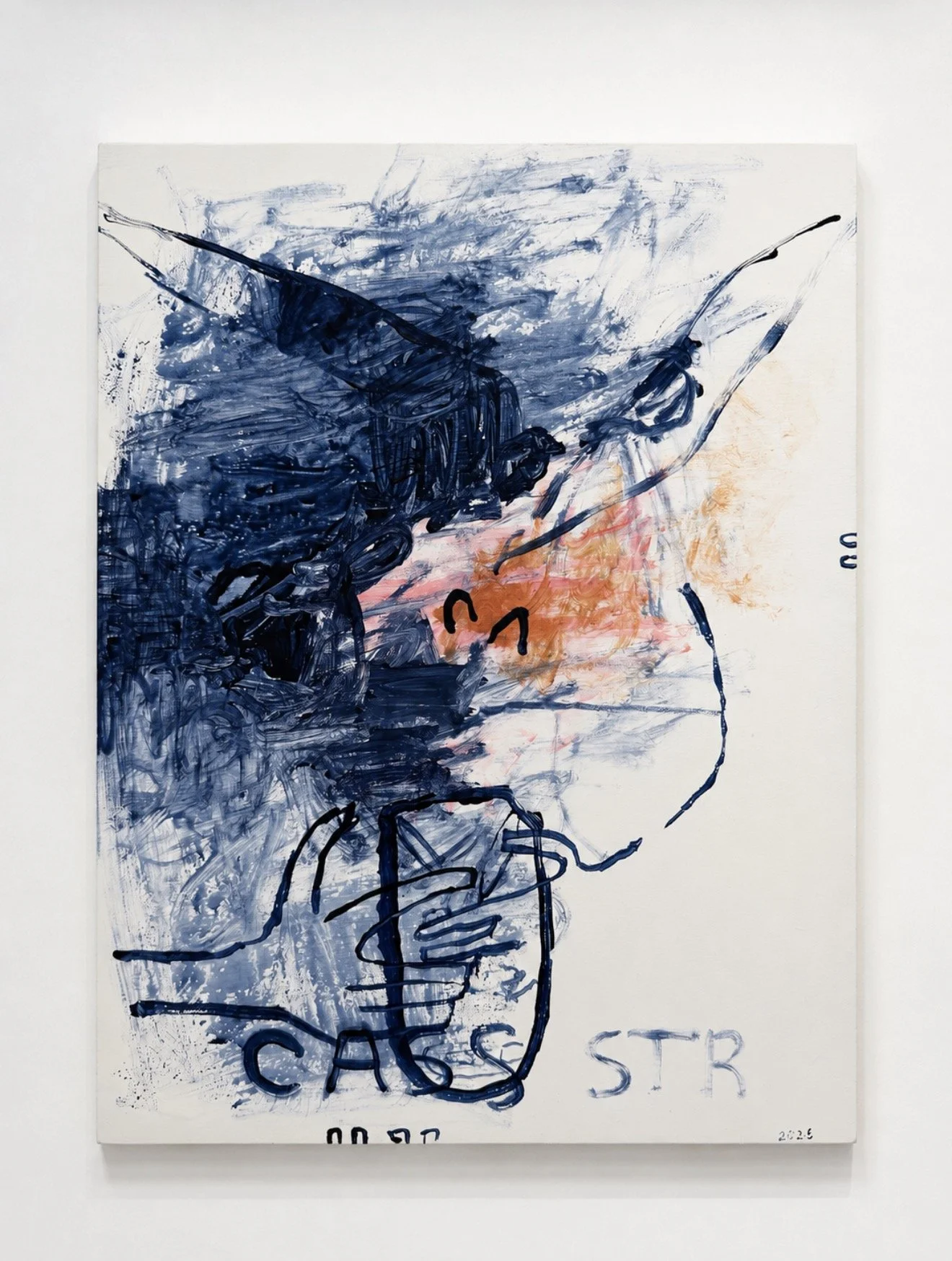
I was completely infatuated with tiki heads as a kid. I was quite cheeky and boisterous and loved cartoons and characters, so I think that was probably the language through which I first understood the tiki Dad was painting. To me they were these strange, colourful, almost magical figures with really distinct personalities. I would draw them everywhere, give them hair, change their expressions and make up different versions of them.
I didn’t have the understanding or language for what I was looking at then. I was just responding to them instinctively as figures and forms. I think that is quite important to the way I work now. My understanding of tiki, whakapapa and my own position in relation to them has changed enormously, and is still changing, but I don’t want to lose that initial freedom I had with how I constructed them.
There is something in the line that has stayed with me from those drawings. I’m more conscious now of what I’m asking of the form and of my responsibility to keep questioning my relationship to it, but I still want the figures to feel alive, changeable and capable of surprising me.
On whakapapa
How does whakapapa find its way into your work?
Whakapapa is a relationship I’m continually negotiating through painting. I think about my ancestors every day. Sometimes quite literally. What would they think of this? Would they be proud of me? Am I doing enough?
Making paintings away from Aotearoa has probably made me think about whakapapa more. There is a distance that I’m very conscious of, and painting has become one of the ways I navigate that. I don’t really think of whakapapa as something I’m trying to illustrate in the work. It’s more like a structure underneath it, something that shapes the way I understand where I’ve come from, where I am now and how I exist in the world.
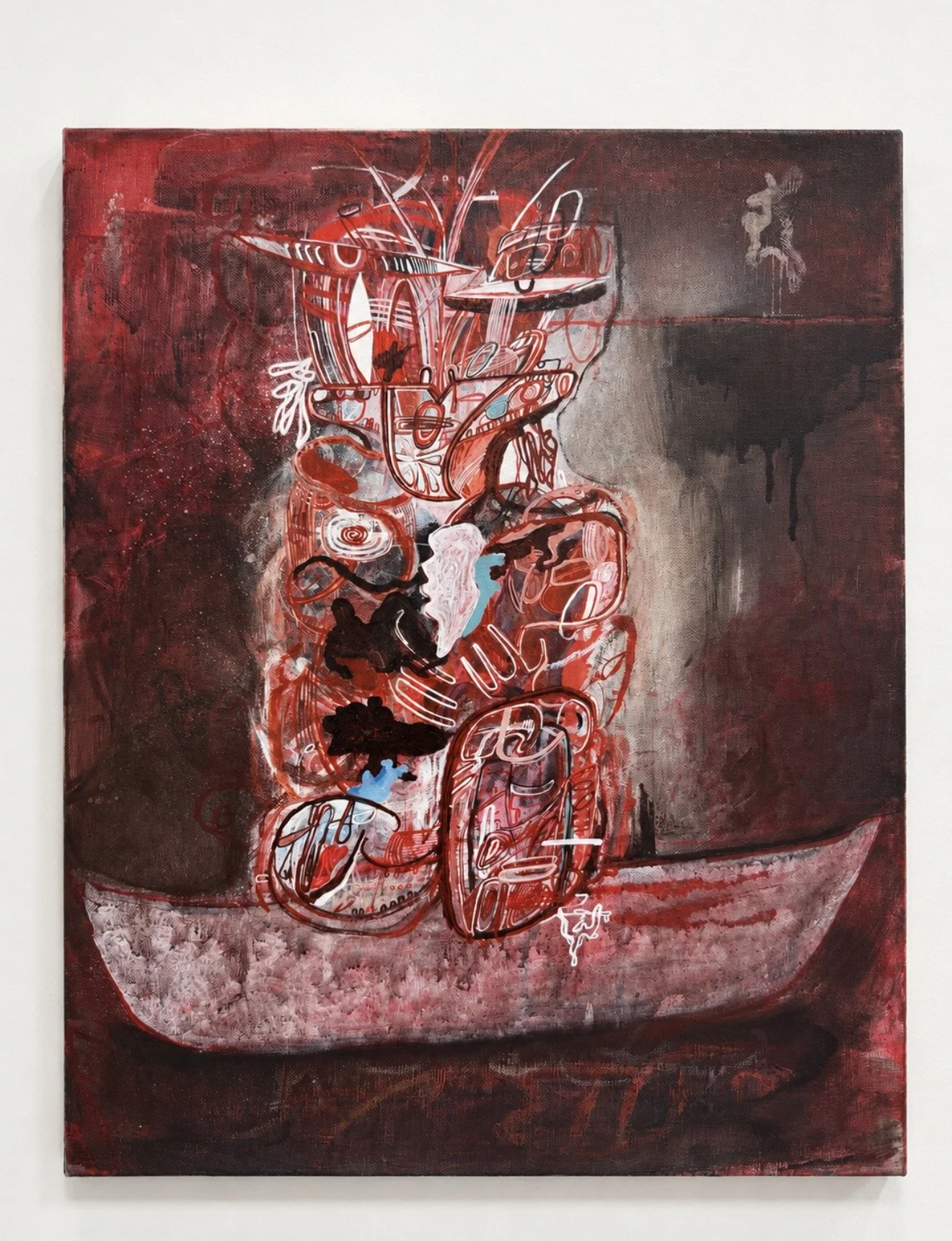
The tiki figures are part of that. They aren’t representations of particular tīpuna, but over time they’ve developed a presence of their own. I think of them as versions of myself, and sometimes they make those questions in my head become tangible things.
I don’t think painting is going to give me an answer or allow me to arrive at some complete understanding of my whakapapa. I’m more interested in the fact that the relationship is ongoing.
On influence
Who or what has been influencing you lately?
Fiona P! Fiona Pardington has been a really important influence on me over the last 12 months, particularly because her work has given me another way of thinking about the power of an image and whakapapa.
Her thesis, Towards a Kaupapa of Ancestral Power and Talk, has really stayed with me. It made me think about the difference between making an image that represents something ancestral and an image that comes to hold a presence of its own. That distinction has become really important for my work.
She writes, “there has always been in my mind, a direct relation between the soul and the photographic portrait.” I totally see that aliveness in the birds she photographs. I feel their souls! They aren’t reduced to specimens or symbols. There’s a sensitivity in the way she
looks at them, and the photograph doesn’t feel like a passive record of something that existed before it.
I’ve actually started looking at birds differently because of her work. Every time I see one now, I find myself asking some of the same questions that I ask of the tiki. Where has it come from? What has it seen? What stories does it carry? Where is it going? They move across land and water, between places, and there’s something about that which feels particularly significant to me when so much of my own work is about distance, movement and connection to place.
I think the best art does that. It follows you out of the gallery and changes the way you see things in everyday life. It shifts the furniture around a little bit. Her work has genuinely changed the way I see the non-human world, and it’s made me think about how I achieve that energy in my tiki. I’ve drawn these figures over and over again. They’re invented, but they no longer feel like just an image or symbol to me either. Through that repetition they’ve accumulated something of their own. I feel their presence when I’m making them. Pardington’s work helped me understand something about that relationship that I hadn’t really been able to articulate before.
Her intellectual, spiritual and intuitive approaches to making don’t seem to be separated from one another. I really admire that. It makes me want to be in the studio every day.
On looking
What are you noticing at the moment?
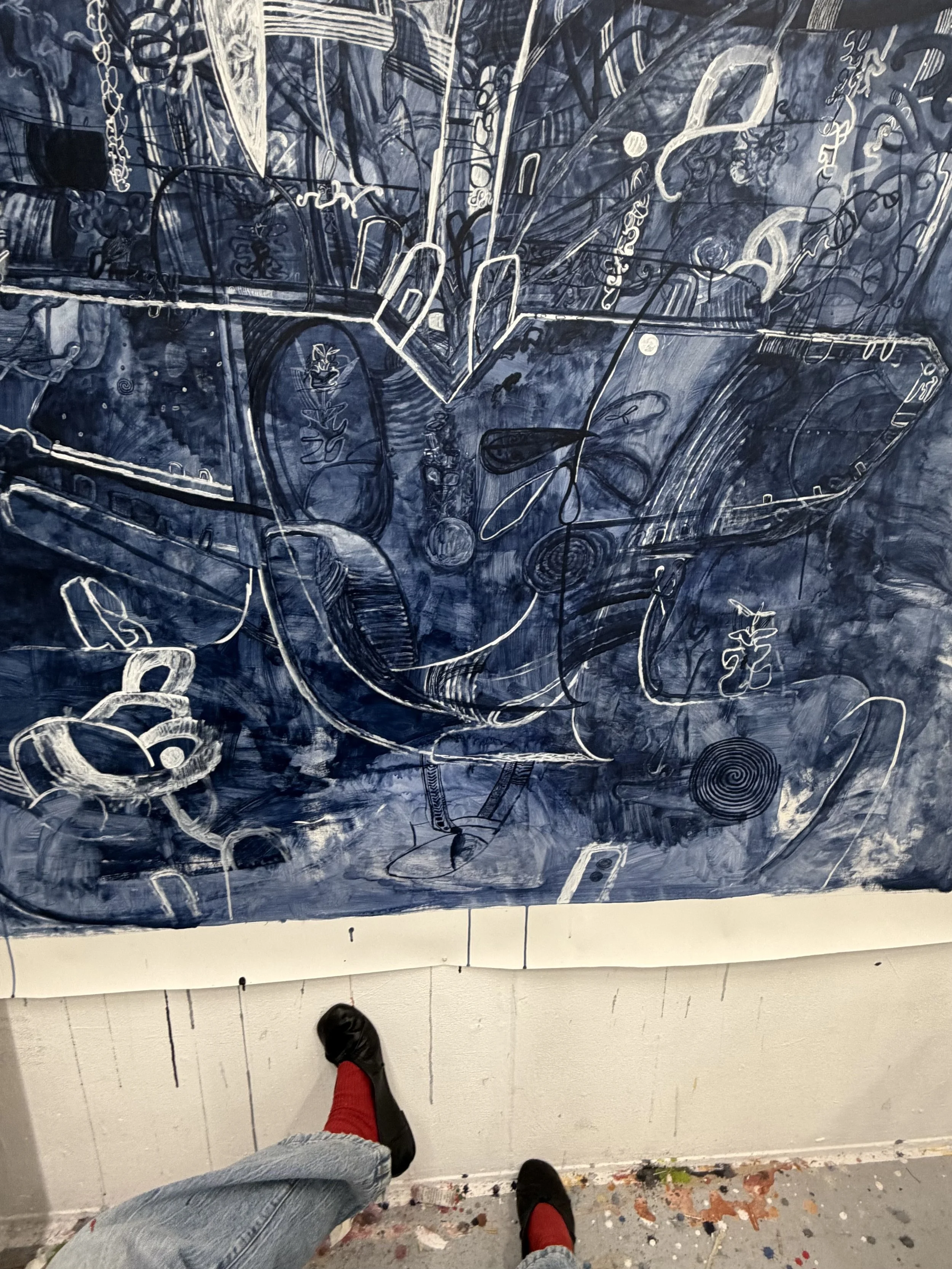
I’ve been thinking a lot about the way younger people construct identity now, and particularly about our relationship to time. There’s so much access to the past at once. You can be looking at something your grandparents wore, listening to music from twenty years before you were born and seeing something made yesterday within five minutes of each other. The boundaries between generations feel quite porous. Things don’t necessarily disappear anymore, they keep resurfacing in different forms.
I think that complicates the idea of what it means to be contemporary. We’re forming our identities from this huge archive of things that weren’t necessarily made for our generation, but can still feel completely immediate to us. A reference from 1975 doesn’t have to feel historical just because it predates you. It can become part of how you dress, what you listen to, what you make or how you understand yourself now. Identity becomes this strange mixture of inherited, rediscovered and completely new things, rather than something that belongs neatly to the moment you were born into.
I’ve been thinking about that alongside futurity in Māori art, although I’m cautious about talking about futurity as a new direction. Māori artists have been imagining different futures, questioning fixed ideas of tradition and pushing against expectations of what Māori art should look like for a long time. I think what interests me is how those conversations keep changing between generations, and what becomes possible for each generation because of the work that came before them.
He Ao Āpōpō, He Ao Tea: Māori Futures at Te Whare o Rehua Sarjeant Gallery in Whanganui made me think about that recently. I’m interested in the idea that whakapapa can operate in more than one direction. We often talk about it in terms of ancestry, inheritance and memory, but whakapapa also extends forward.
I think that’s where tradition becomes really interesting. I don’t see it as something static that you either preserve correctly or reject in order to be contemporary. Change doesn’t necessarily mean moving further away from something. Sometimes it might be the thing that allows it to continue. As a young Māori artist, that leaves you with this really interesting question of what you do with everything that’s come before you, and how you continue to contribute to it for whoever comes next.
I’m also noticing how much pressure there is for identity to be explained. Who you are, where you belong, what something means, what position you take. I’m finding myself increasingly interested in the opposite: things that remain a little unresolved or contradictory. Life isn’t straightforward. You can feel deeply connected to somewhere while choosing to live somewhere else. Something can carry history without looking historical.
I love seeing how artists exist in that space.
On community
What do you think makes a good creative community?
Trust, love, intergenerational exchange, understanding and delusional levels of belief in each other.
Being surrounded by people who understand what you’re trying to do is really important. Most people don’t necessarily know what it means to be an artist or to pursue a creative practice. They might question your work or the way you’ve chosen to live, without always seeing the commitment behind it. A support system that believes in you without question, wants the best for you and recognises the effort and discipline that goes into the work makes the difficult days worth it.
I’m really lucky to have that kind of support from the people in my life. They keep me grounded and focused, but they also give me confidence on the days when it’s hard. Pursuing an artistic practice can be lonely. It’s just you in the studio, day after day, spending a lot of time in your own head. Reassurance from someone you respect can be pretty vital in the relentlessness of it all.
At the same time, some of my closest friends don’t have creative practices at all, but we understand each other. I don’t think you have to be a creative person to be part of a creative community. My friendships also span different generations, which I really value. I learn so much from people who have lived longer than I have and have completely different experiences of the world, and I like to think they learn things from me too. Knowledge and perspective should be able to move in both directions.
Everyone is special and has their own way of contributing to the world, and I love finding out what that is in people. My friends are quite eclectic in the way they live their lives. We’re interested in different things, we teach each other things, we debate, and our lives don’t look the same. Being around people who see and move through the world differently stops your own perspective from becoming too small. They also know me completely outside of my painting and give me a space where I can just be myself. I think having that is just as important as having artist friends who I can take unfinished work to and trust to tell me when something isn’t working.
And it has to go both ways. You have to show up for them too, take what they do seriously and be generous with your attention. I think people do their best work when they feel both supported and challenged.I have so many conversations with women who apologise for their bodies, no matter their age. ‘Sorry about my belly,’ ‘Sorry about my upper arms,’ it’s kind of terrifying when you stop to think about it— apologising for your being, which is so beautiful. But on the opposite side of that, it’s incredible to have people come in, try things on, and then overhear a muffled noise from the changing room—a yelp, or a moment of total thrill. There’s been a number of women my Mum’s age that may be inclined to be reserved or shy about their bodies, only to try something on that feels and looks amazing, and have it change their entire demeanour. I mean, I hear it all the time: ‘I don’t like my upper body,’ ‘I don’t want to show too much decolletage because I’m 60,’ and all I think is, ‘Come on, you look fantastic!”. It’s quite a Kiwi trait, as well. You don’t see women in Italy strictly wearing shirts instead of tank tops because they’ve surpassed 40. It’s important to distinguish that it’s not about being ‘sexy’, it’s about wearing what you want. Feeling nice. And, if you feel a little bit hot, that’s great, you know!
On making your own path
Was becoming an artist something you always imagined for yourself?
As a kid I had big aspirations. Nothing was too big of a dream. I was so excited about the future and imagined all sorts of lives I wanted to live. I think when you’re young you just assume you can do all of these amazing things, and then you get older and realise that actually building a life you really want isn’t that easy.
When I think about it now, the way I paint, and how obsessive and particular I can get about things, hasn’t really changed that much. It’s just taken me time to figure out how to build a life around it. Obviously I’m just at the beginning, not only with the painting itself, but with everything that comes with being an artist. How to make money, how to protect my time, what kind of art world I want to be a part of, who I want to surround myself with and what I actually want a life as an artist to look like.
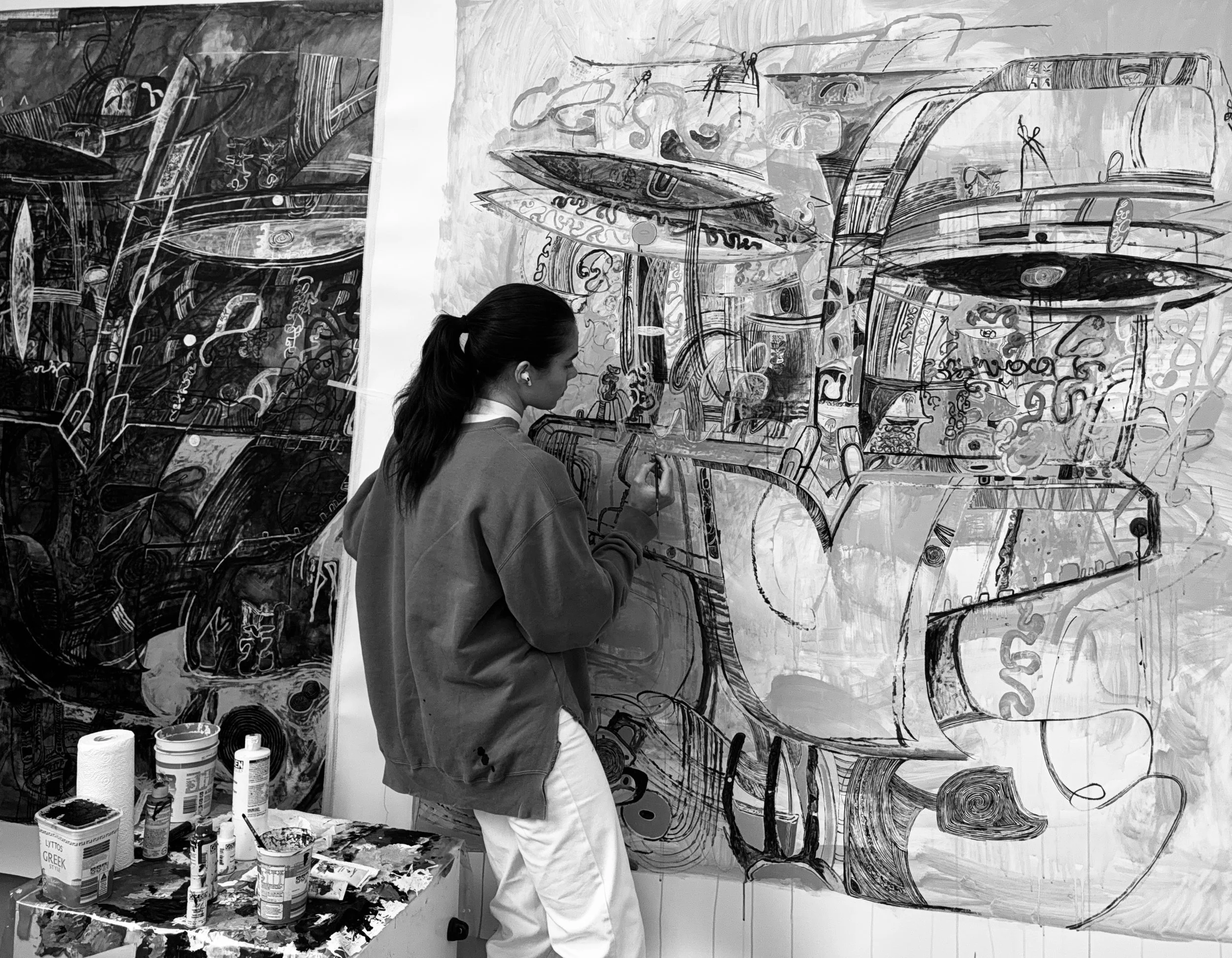
I put painting first now. I’m at a point in my life where I don’t have many responsibilities outside of myself, and I know that won’t necessarily always be the case, so I want to make the most of that while I can. I don’t really give myself the option of it not working.
On home
What makes somewhere feel like home? Can you also share your life over the last few years and if it did involve moving and uprooting?
Home for me is mostly the ordinary things that make a place feel like mine. Being with my family, having my things around me, having space to think and have fun, making my coffee exactly how I like it. The complicated part is that the people I love live all over the place. I’m lucky to have a few different places that feel like home, but I think that also leaves me feeling slightly unsettled sometimes. I’ve become quite good at making a home wherever I am, while always feeling connected to somewhere else.
I’ve always been like that though. Even growing up, I was constantly at my friends’ houses. I was barely ever at my own house. My friends’ houses were definitely extensions of home. I think I learnt pretty early that feeling at home didn’t necessarily have that much to do with where I actually lived.
I went to boarding school at 15, so even in high school I was constantly travelling back and forth. Then I spent four years in Wellington, had some time in Russell, and since 2023 I’ve been living between Russell and Melbourne. I think I’ve moved houses four times since 2024. So I haven’t really had the experience of staying in one place for very long.
I think my threshold for one routine is about three months before I start wanting a change of pace. I love being in both Melbourne and New Zealand, just for different reasons. I’m such a Kiwi girl at heart, and I miss the nature, the land and ocean, my dog, and being around Kiwis! Then after a while, I start missing the energy of a city and the life I have in Melbourne. Sometimes one place and one way of living for too long starts to feel a bit unbearable. I really admire my friends who can do the same thing every day, have their whole year/lives planned out and genuinely love it. I’m just not very good at that. My Nana texts me every other week asking where I am, which probably says it all.
Russell is the exception. It’s the one place that has been a constant throughout my life. I grew up in Palmerston North, which shaped a huge part of who I am because of my childhood and the people I met there, but I don’t have a particularly strong attachment to the place itself anymore. We spent every summer in Russell as kids, friends would come and stay, and now my parents live there. So it definitely feels like home to me, even though I know it’s not necessarily where I want to build my life.
I’m really close with my parents, and they’ll probably always represent home to me in a very real way. But as I’ve gotten older, I’ve had to work out how to create that feeling for myself. I’m also lucky to live with one of my best friends, who I’ve lived with, for the most part, since 2020. Through all the different places we’ve lived, she’s been a constant, and I think that has altered how Melbourne feels to me. Moving cities, especially countries, is so hard, and having one person you can come home to and lean on day after day makes such a difference.
Ultimately, I think home is being able to walk through the door loudly, leave your shoes on, sit with someone in silence, stare into the fridge or fall asleep on the couch. It’s the ordinary things.
On the space between making and looking
How does being surrounded by other artists affect your own practice?
Growing up with two parents who are artists has obviously shaped the way I see the world, so inevitably that finds its way into my work. I think being surrounded by artists from a young age also made me very aware that nobody develops a practice in isolation. You’re constantly absorbing things, whether that’s from other artists, conversations, books, exhibitions or just the way people around you think.
I also try to see really good art as often as I can. It keeps my expectations high. When I see something exceptional, my instinct is to go back to my own work and ask how I could push something further. Looking at a lot of art also helps you define your own taste. You start to understand what you respond to, what you don’t, what feels exciting to you and what does nothing. The more you look, the clearer you become about the kind of art you actually want to make.
I think the most creative ideas are the most personal ones. The further you go into your own experiences, contradictions, memories and relationships, the harder it becomes for someone else to arrive at exactly the same place. So I’m less interested in trying to make something that looks completely unlike anything that has come before it. I’m more interested in taking what I’ve absorbed and making it specific to my own experience.
Being around other artists has probably made me less anxious about influence for that reason. I don’t think having a voice means making something that appears to have come from nowhere. It’s what you do with everything you’ve learnt and questioned that eventually becomes particular to you.
On the things outside the studio
What do you do when you’re not making art?
Just chilling, really. I actually really like doing nothing. Watching YouTube, reading, going for walks, working out, being with my friends, going to the market, having a wine, going to the movies…
On a good day
What does a really good day look like for you?
It’s the small things!! My friends and I call them MD moments, mini dopamines, and I try to fit as many of those into my day as possible. Otherwise what’s the point.
My ideal day starts with a coffee. I sit in bed and drink it while watching the news or a podcast, then go to the gym.
I get to the studio around 11 and paint for four or five hours. I actually like what I’m doing. I’ll get a salad or sushi for lunch, another coffee, then keep painting until around 9. I go home to a house full of friends, we have dinner and wine, and I’m in bed by 11.
This definitely doesn’t happen every day, but when it does, it’s a really good day.
On reading and listening
What are you reading or listening to at the moment?
I’m always listening to Lykke Li, Alicia Keys and Ms. Lauryn Hill. They’re probably the three I come back to the most.
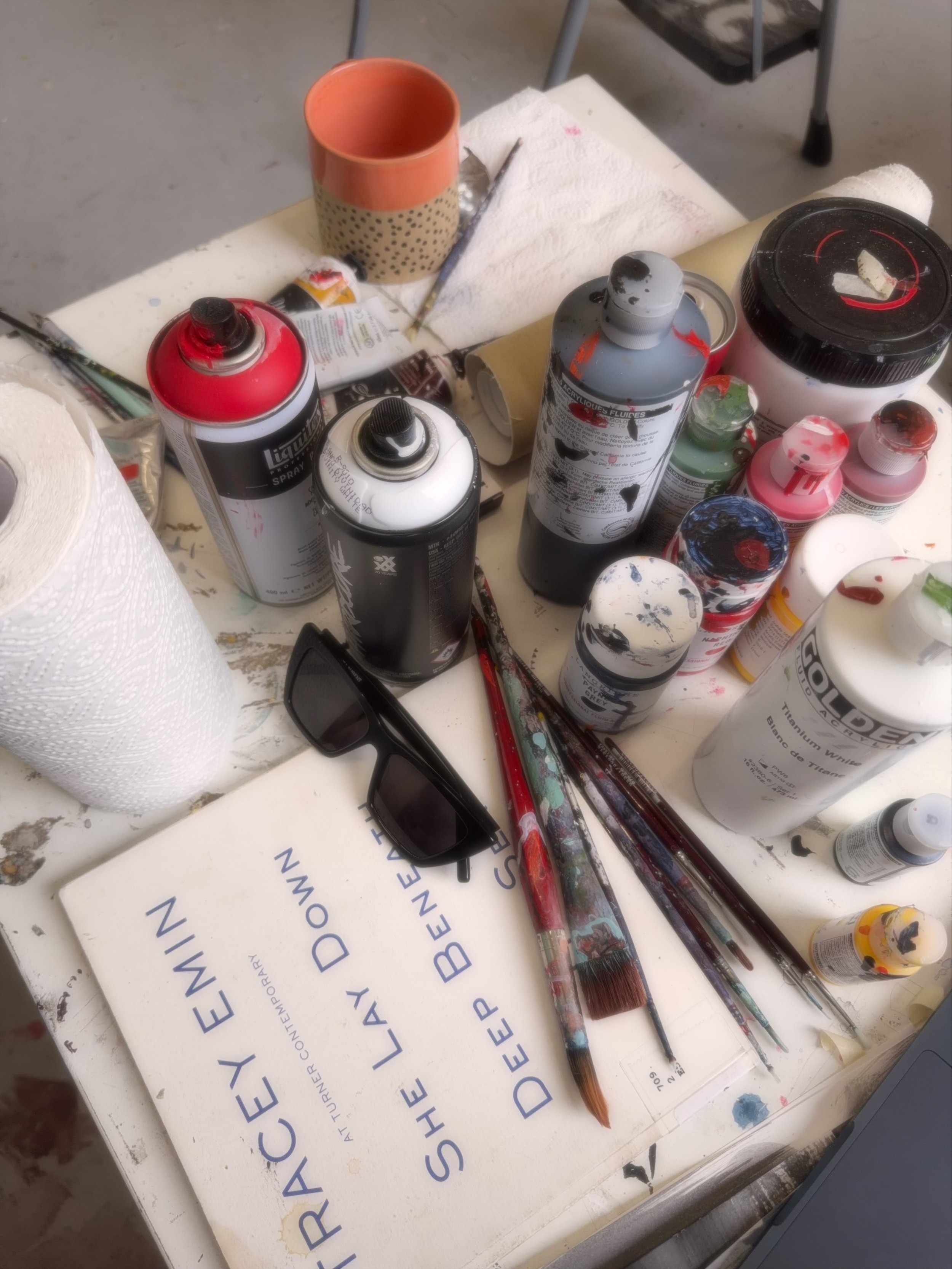
I also just read Tracey Emin’s Strangeland, which I loved. I like how completely unfiltered and personal her writing is. I tend to read pretty sporadically though, usually whatever I’m interested in or researching at the time.