Te Ara Minhinnick’s Venice Biennale Journal
For Māori artist Te Ara Minhinnick, whenua is more than a place. It’s material, memory and whakapapa. Her practice draws on the landscapes of her rohe, working with materials including uku, whenua and onepū to unearth ancestral narratives and stories held within the land.
So when Te Ara travelled to Venice as one of eight participants in Learning from Venice, a new programme taking emerging Aotearoa artists, curators and writers into the heart of the Biennale, she arrived with a particular way of looking at the world.
With her place on the programme fully funded by Naveya & Sloane, there’s a natural connection between the artist and the jewellery house: a shared appreciation for craft, materiality and the things we make that are intended to last.
Here, Te Ara shares her Venice through her own visual journal : a collection of observations, encounters and moments from five days spent looking, learning and taking it all in.
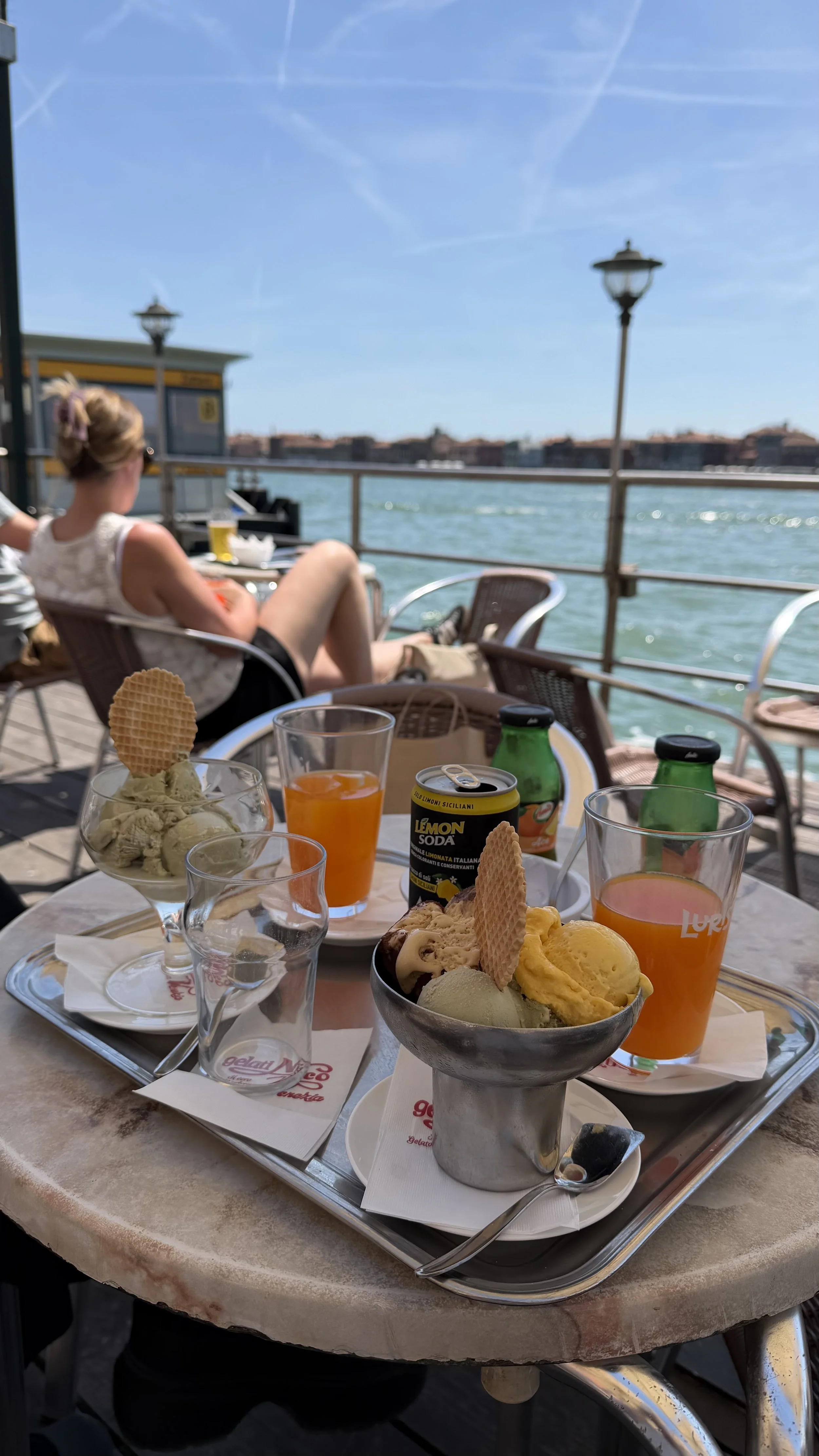
“There is something I can only describe as magical about arriving in Venice by boat. Peak whimsy. That feeling lasted right up until I had to drag my 28kg bag, packed with jackets I did NOT need, to our accommodation in Dorsoduro.
Centro Culturale Don Orione Artigianelli became our base for the week. My room became the place I returned to each evening to peel off my heatwave soaked clothes, recoup, and get the day into my journal.” - Te Ara Minhinnick
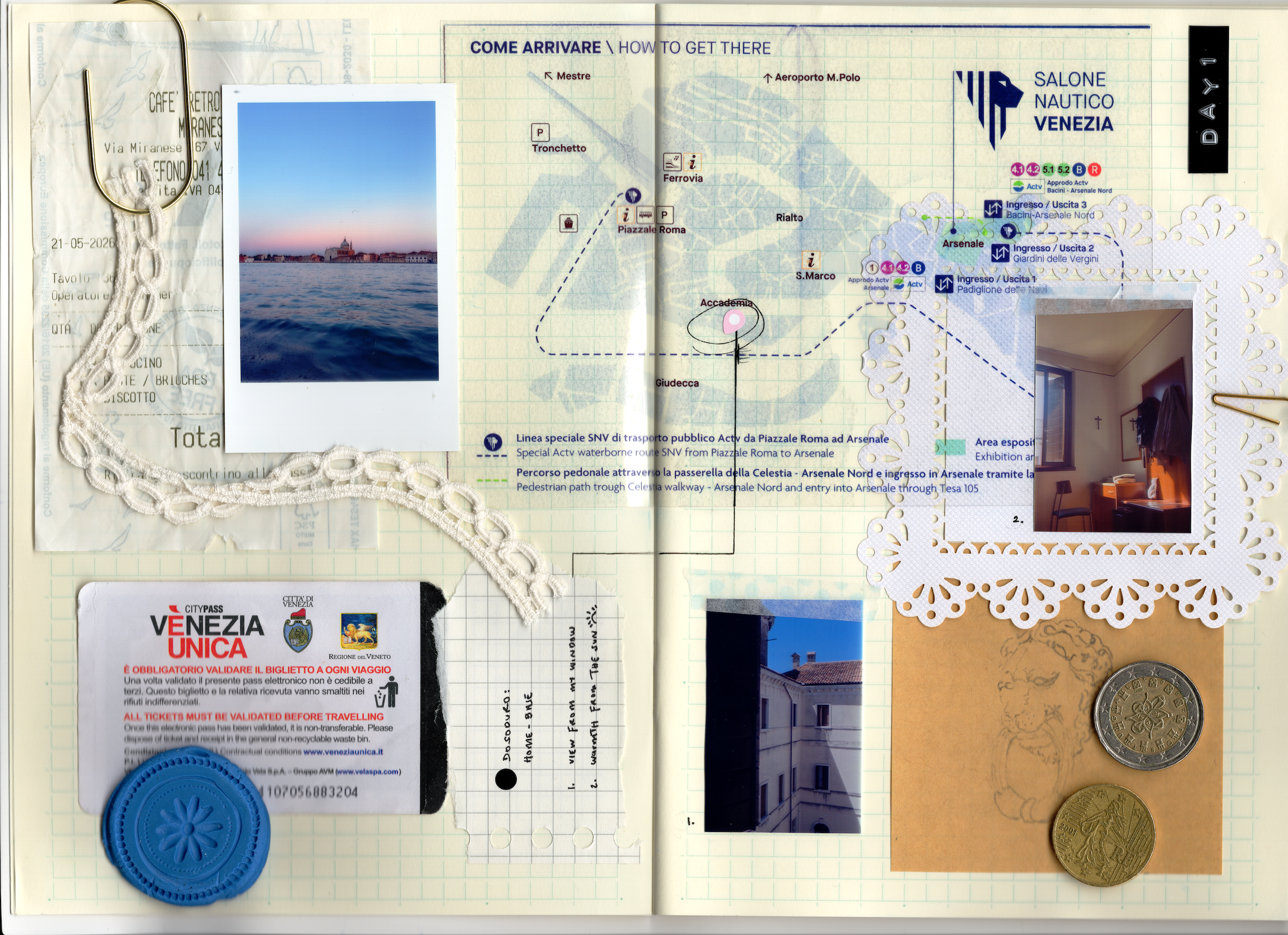
Journal page: Venezia ephemera, map to accommodation
DAY 1
On Monday, I met the rest of the roopu properly for the first time: artists, writers and curators from across Aotearoa. We gathered in the gardens nearby for introductions and whakawhanaungatanga, with our kaiaawhina Angela Bishop and our kaihautuu Christina Barton opening the programme and setting us up for the week ahead.
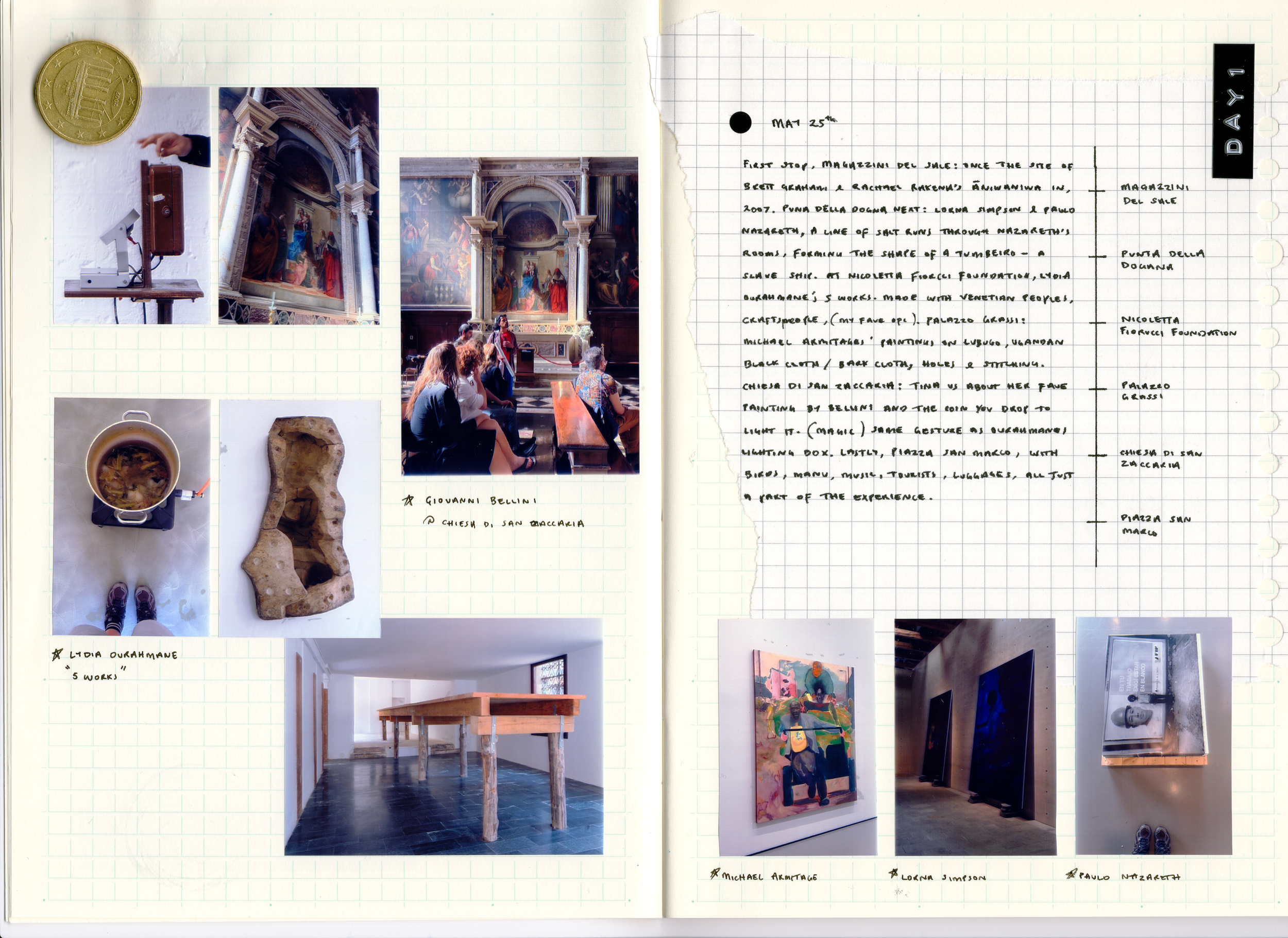
Journal page: Giovanni Bellini, Lydia Ourahmane, Michael Armitage, Lorna Simpson, Paulo Nazareth
Because many of the main Biennale venues were closed on Mondays, our first day became a walking introduction to Venice, moving through offsite exhibitions around Dorsoduro and further into the city.
We began at the Magazzini del Sale, where Brett Graham and Rachael Rakena's Aaniwaniwa had been shown in 2007. I do not know if you can feel the absence of a work you never saw, but I stood there and tried to feel its mauri nearly twenty years later.
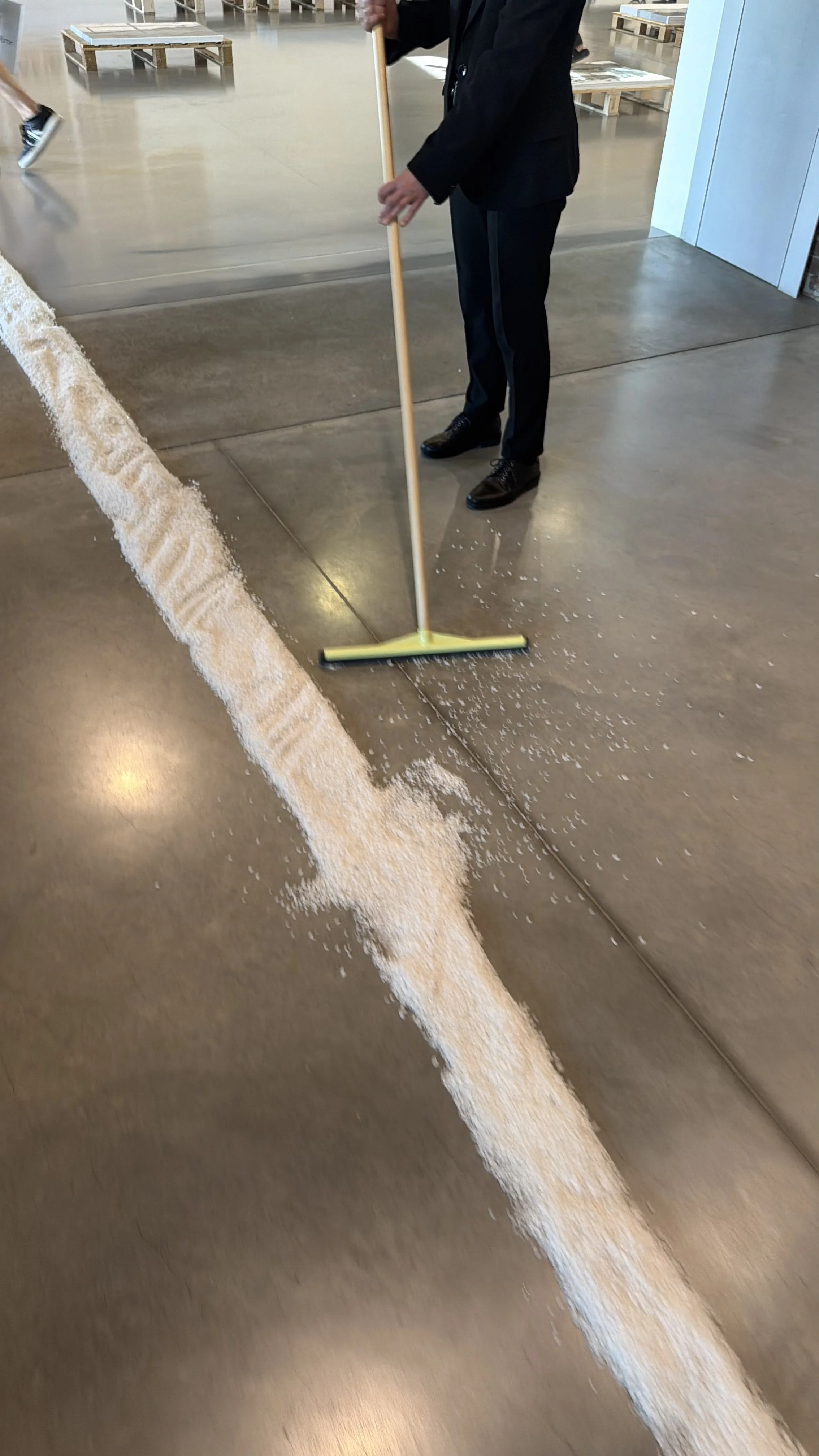
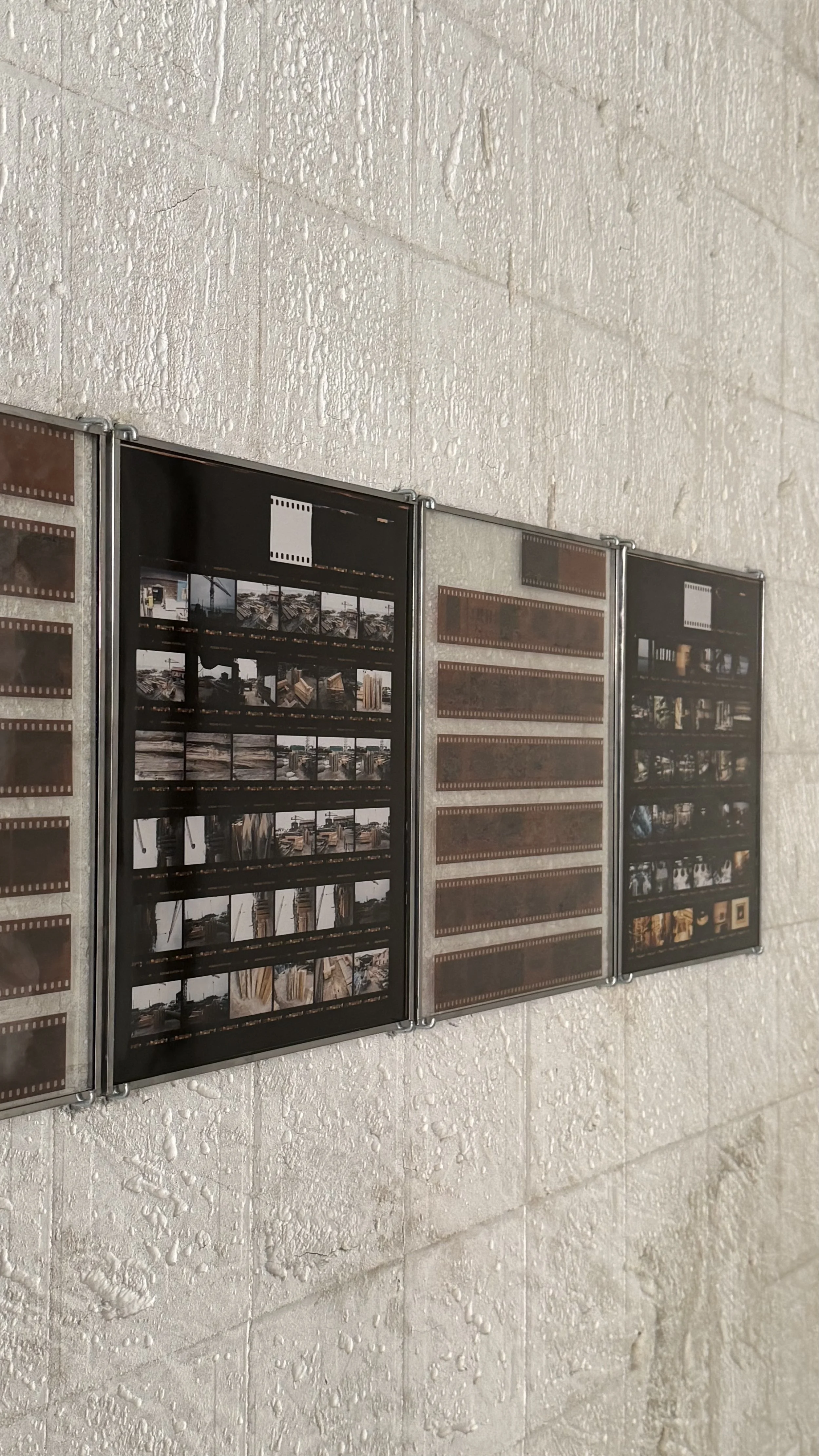
Above : Paulo Nazareth at Punta della Dogana (left) and Lydia Ourahmane at Nicoletta Fiorucci Foundation (right).
From there, we went to Punta della Dogana for Lorna Simpson’s Third Person and Paulo Nazareth’s Algebra. A line of salt ran through Nazareth’s exhibition. At first, it looked like something spilled across the floor. The longer I followed it, the more it resolved into the outline of a ship: ships carrying goods, ships carrying enslaved people, and ships now carrying migrants and refugees. It took me almost the whole length of the ship to clock what I was walking beside.
Lydia Ourahmane's 5 Works, at the Nicoletta Fiorucci Foundation, was one of the exhibitions I still think about often. We were introduced to her practice through the stories and context surrounding the works, many of which came out of exchanges with people, trades and organisations already in Venice. It did not feel like Venice had been collected and Disneyfied for us. The work remained tied to the lives of people who would still be there after the Biennale crowd left.
At Palazzo Grassi, I kept returning to Michael Armitage's paintings on lubugo, a Ugandan barkcloth that made me think of aute.
Later, at Chiesa di San Zaccaria, Christina told us Giovanni Bellini's altarpiece was one of her favourite works, then dropped a coin into the box and the painting lit up. A few hours earlier, we had encountered that same gesture in Ourahmane's exhibition, where a coin-operated church lighting mechanism had been installed and used to illuminate the different rooms.
We came out of the church and into the fullness of Piazza San Marco: packed souvenir trolleys, cheeky birds, red rose sellers, a cacophony of sounds, and people moving in every direction.
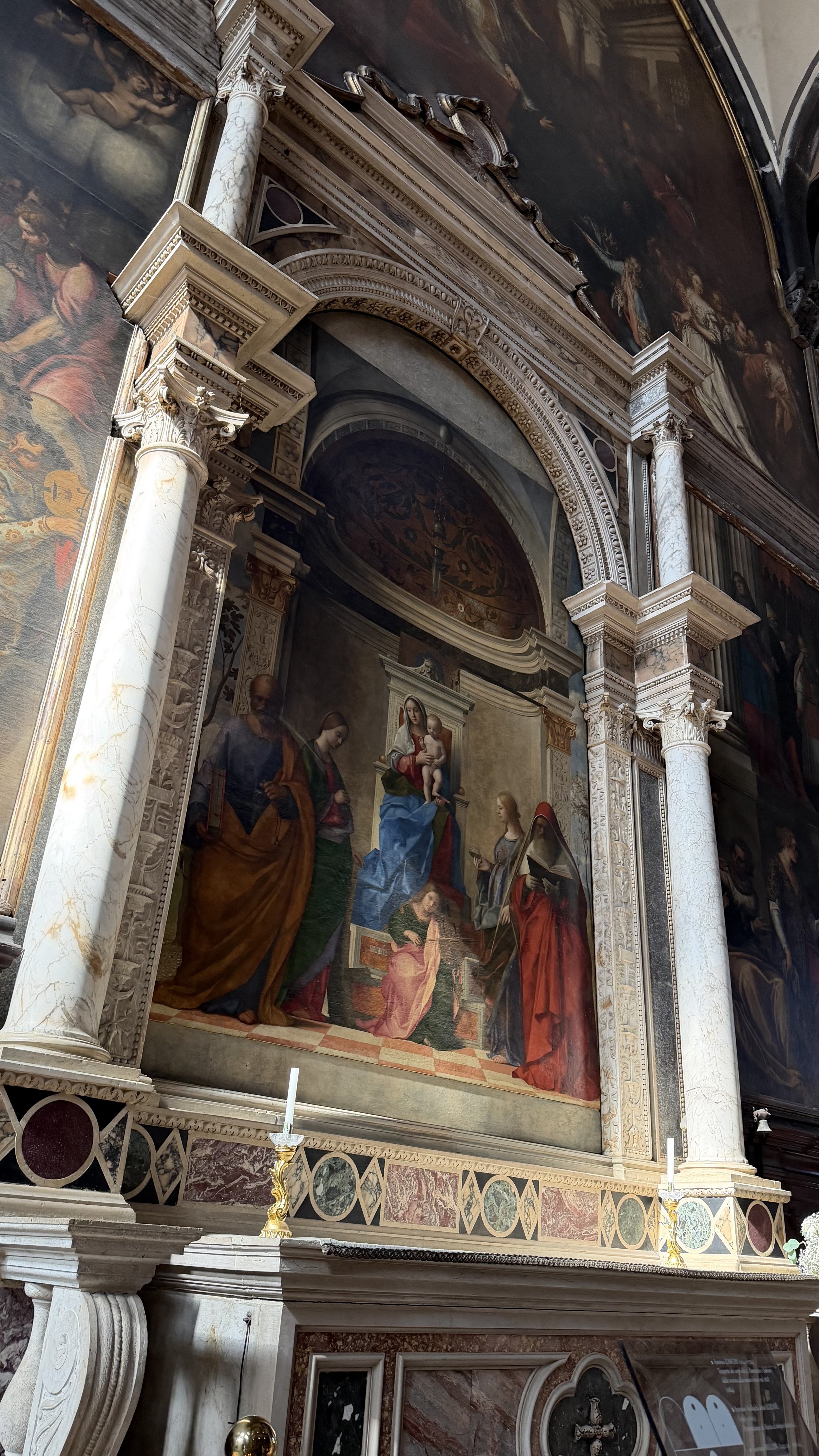
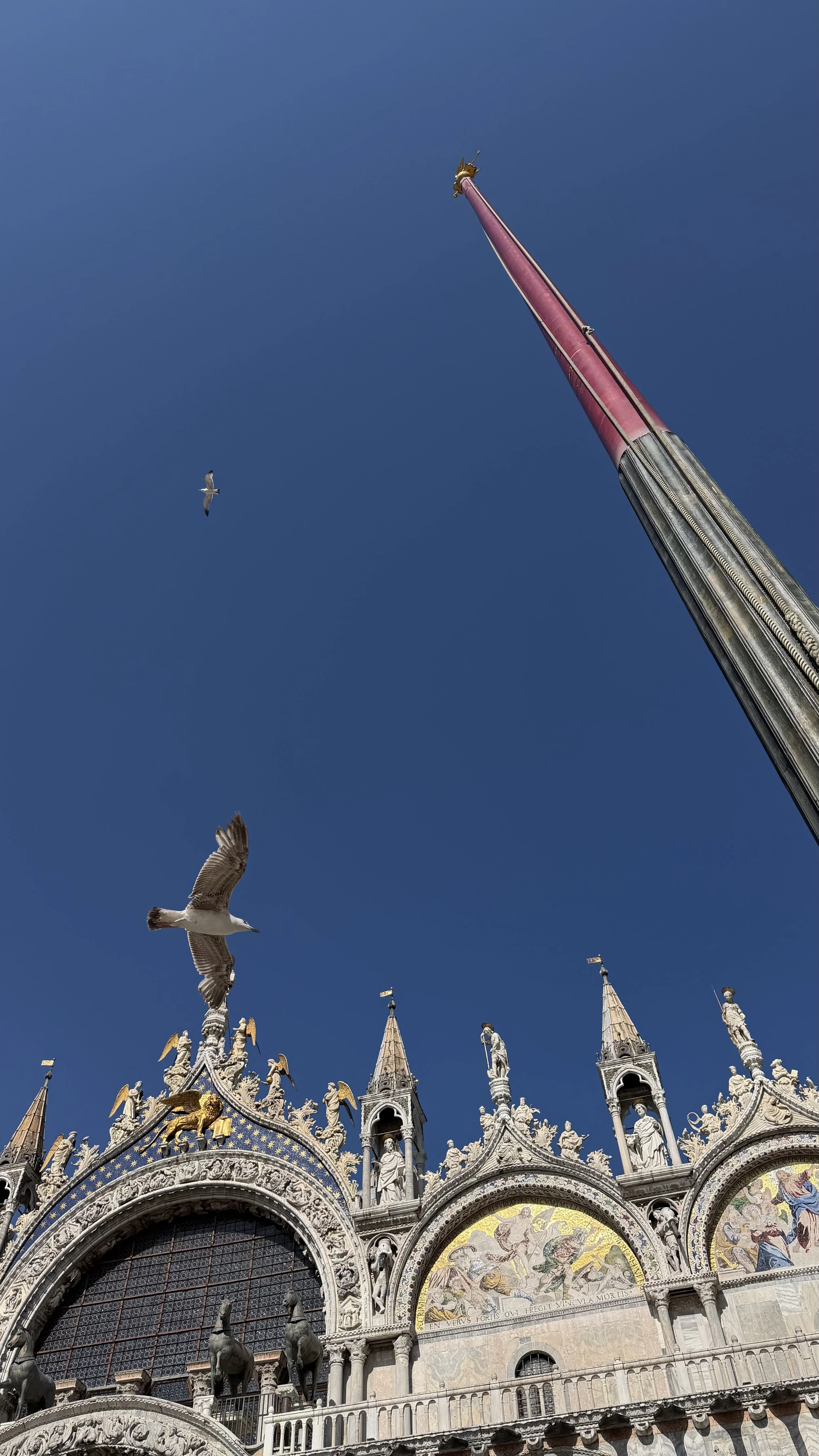
Giovanni Bellini at Chiesa di San Zaccaria (left) and Piazza San Marco (right).
Venice already gives you so much to look at. I had only experienced a limited amount of art outside Aotearoa before this trip, and I could not tell whether I was overwhelmed by the art, Venice, the heat, or having to think while moving through all three at once. Probably all of it.
DAY 2
Tuesday began back in the courtyard for our morning hui. We each shared highlights from the previous day, and for most of us Lydia Ourahmane’s work came up. I spoke about the way her practice had responded to the conditions of Venice, including its people, and hoped to find other artists working in similar ways as the week went on.
The day’s schedule was packed. It included our first visit to one of the Biennale’s main sites, the Giardini, along with a number of presentations outside of it. It was going to be our first full day moving through the Biennale!
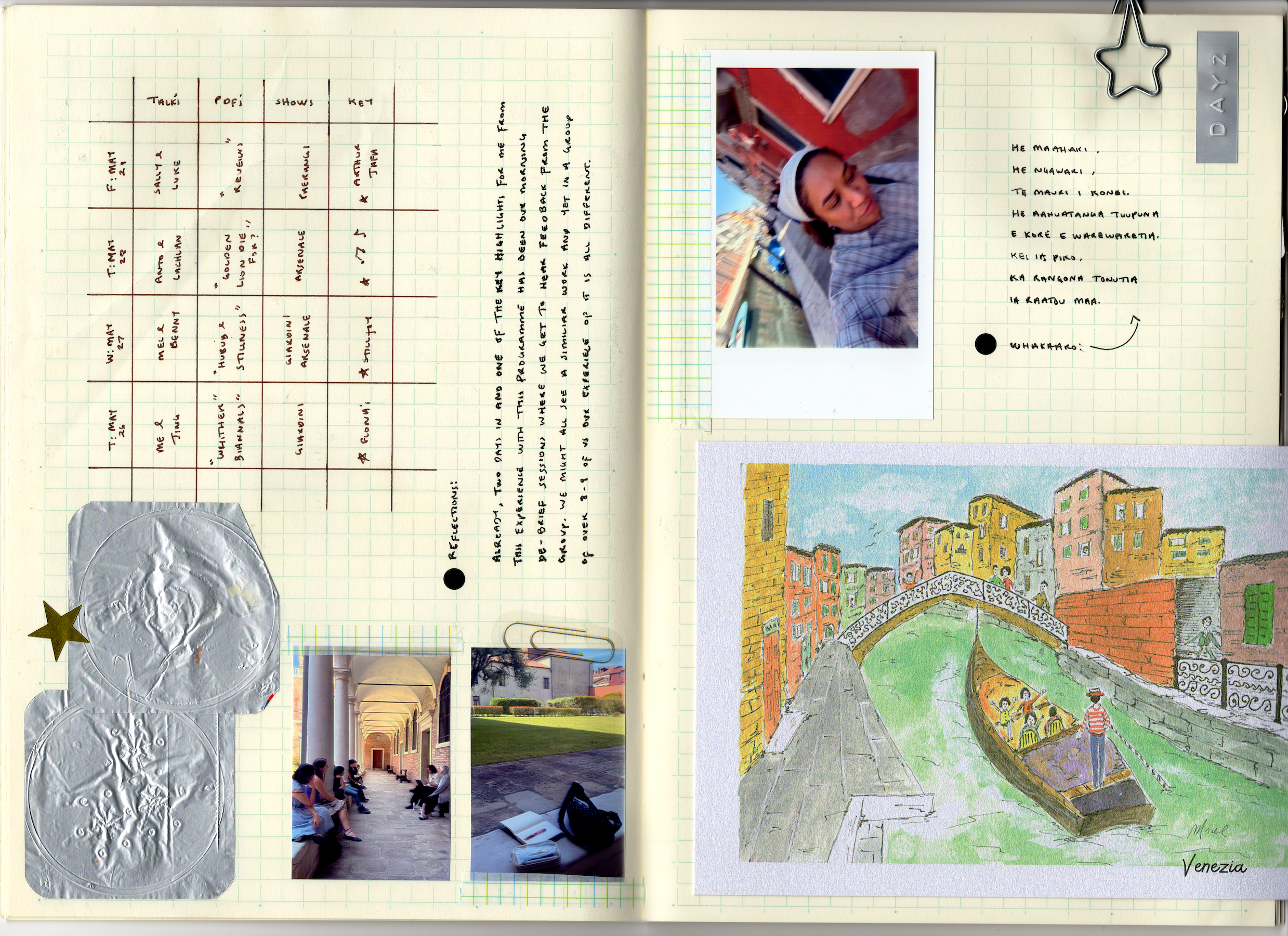
Journal page: Schedule, embossings, morning meetings, Venezia postcard
One of our first stops was Sownd, the Wales in Venice presentation by Manon Awst and Dylan Huw. I started noticing all of the supporting material that sat around the exhibition as well as the works themselves. Things like books, catalogues, reading lists and essays. Along with ephemera collected from the Wales presentation, I noted down a couple of books from their reading nook to add to my growing TBR: Cynefin by Carwyn Graves and The Hydrocene by Bronwyn Bailey-Charteris.
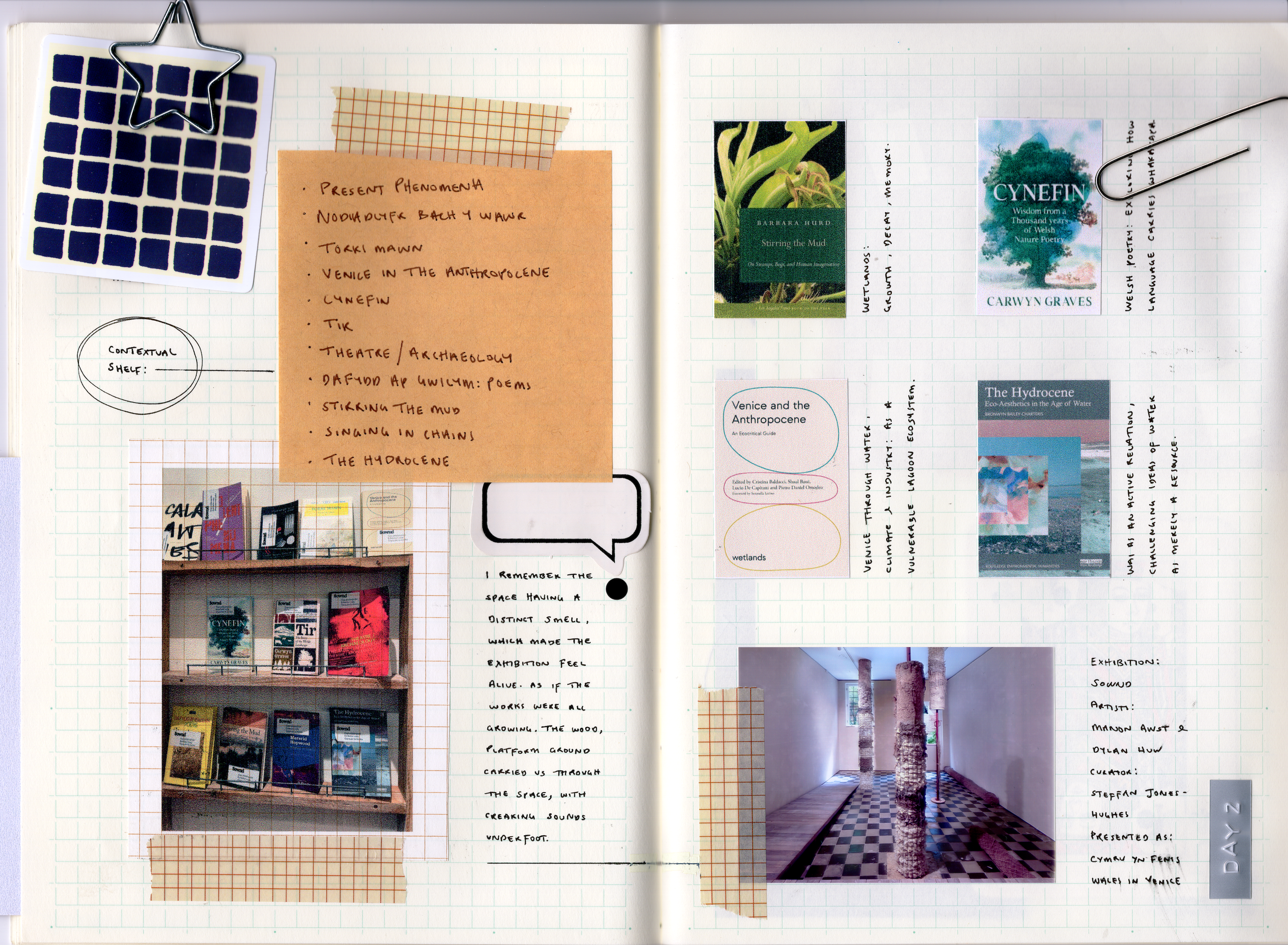
Journal page: Wales bookshelf in reading nook, my growing TBR list
From there we visited Dr Fiona Pardington’s Taharaki Skyside, the Aotearoa New Zealand presentation. Our kaiarahi through the exhibition, Mya Morrison Middleton, sat with our roopu and talked us through the show and some of the responses she had been hearing from visitors. One of the first things people questioned was whether the large portraits of manu were paintings or photographs.
Surprisingly, what I noticed first wasn’t actually the manu, but a pounamu mauri stone sitting in the middle of the space that visitors were invited to touch. The pounamu’s green seemed almost luminous in the darkness. It felt like you could almost see its mauri rebounding onto the surrounding walls. It made me think of the koowhatu at our marae at home that I have rubbed since I was a child.
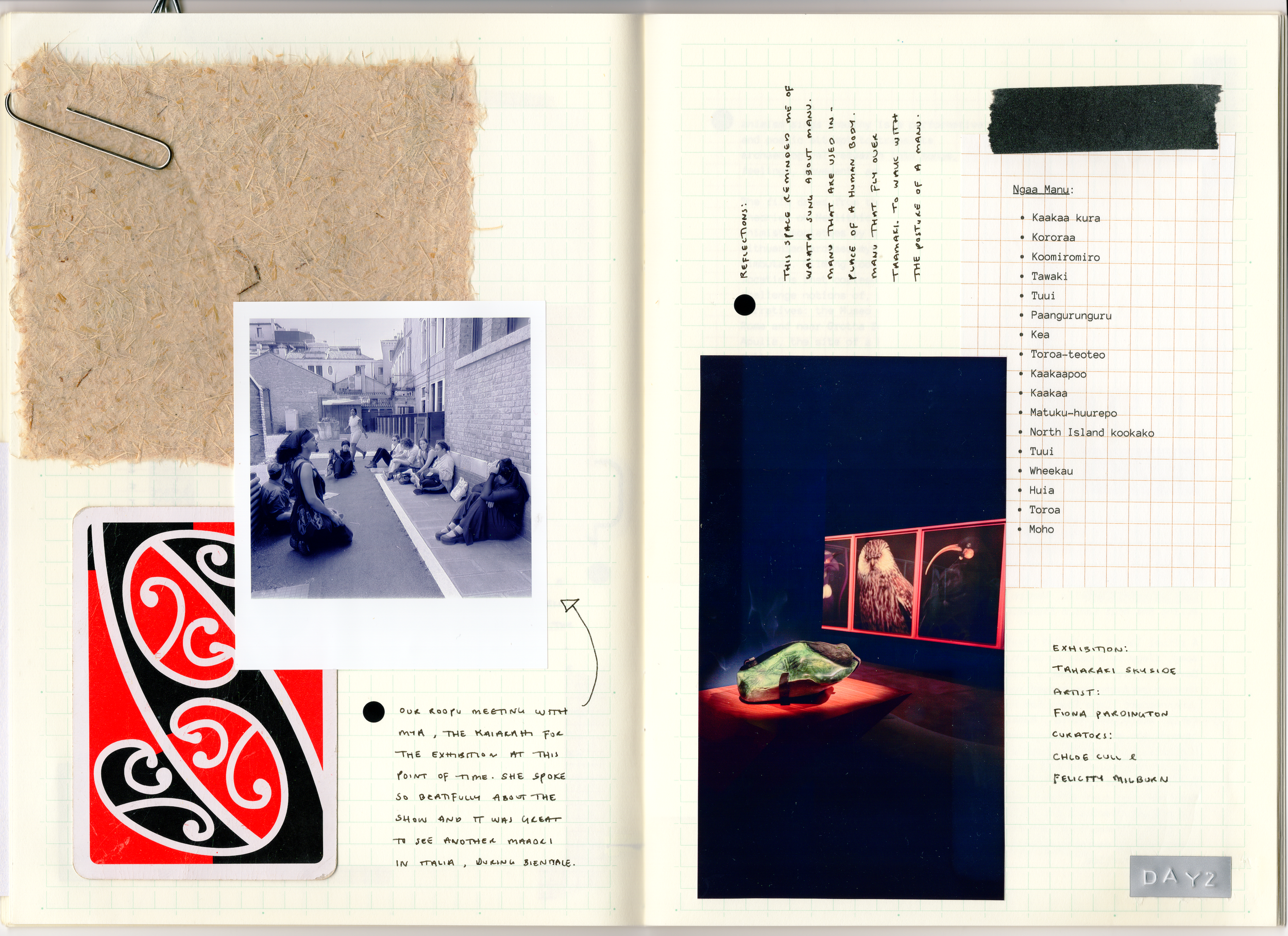
Journal page: Dr Fiona Pardington Aotearoa Pavilion
Soon after, we walked into Chiesa di Sant’Antonin to see Gabrielle Goliath’s Elegy, an independent exhibition running alongside the Biennale. When people ask me which work impacted me most, this is the one I talk about.
Across the screens, each singer held a single note for as long as their breath allowed. As one voice dropped away, another stepped in and picked it up. It reminded me of waiata tautoko back home, where a leading voice starts and everyone else joins in after to carry it on. Inside the church, the voices seemed to move through the whole space, almost multiplying their presence.
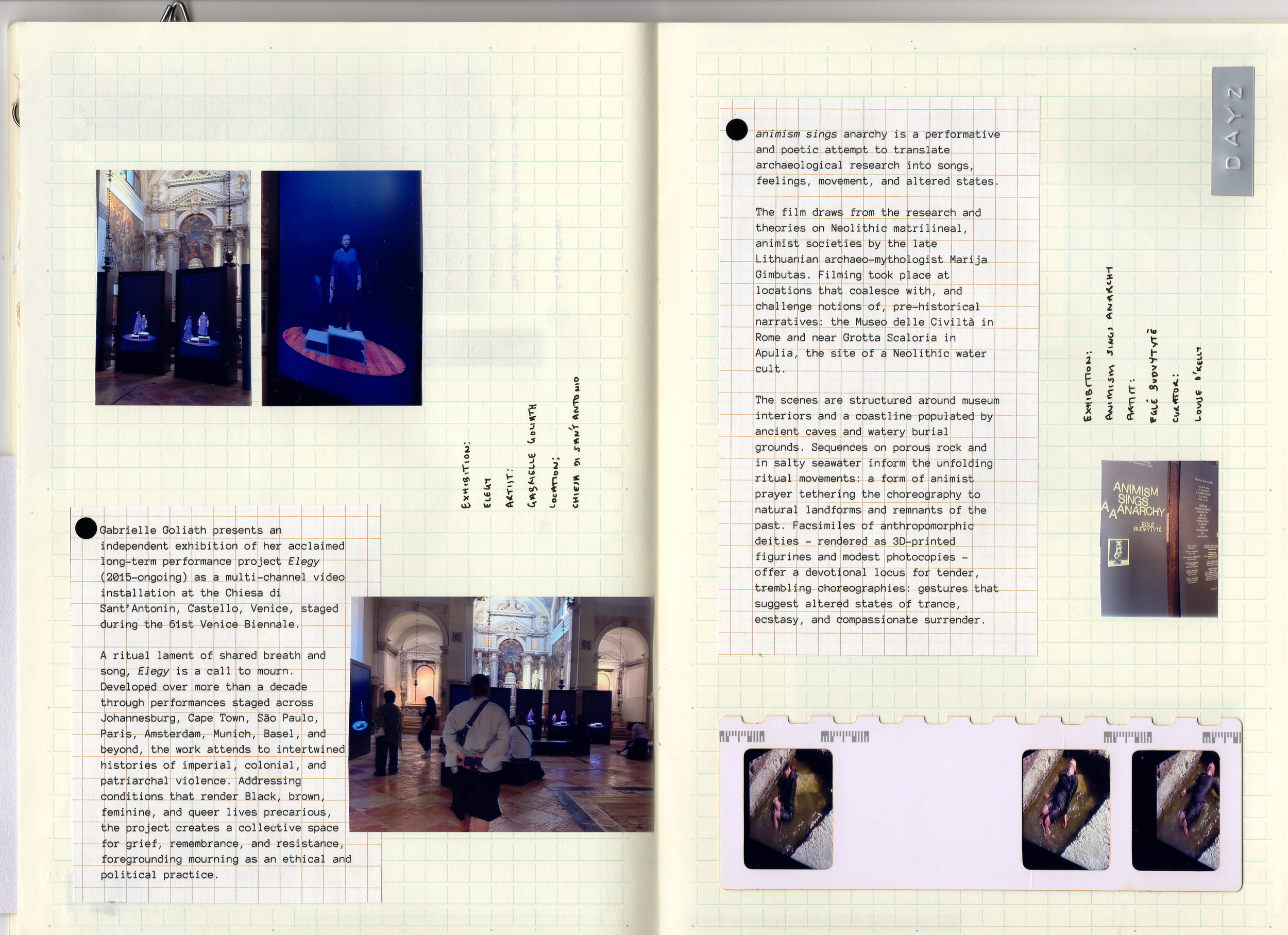
Journal page: Gabrielle Goliath and Animism Sings Anarchy
Then we finally made it into the Giardini!
I do not think I had ever properly pictured what it would actually be like. Countries had their own buildings scattered throughout the gardens, and you could walk from Japan to Britain, Canada to France within minutes.
It reminded me of Rainbow’s End, or what I imagine Disney might be like. Every building had its own entire world inside it. You would come out of one exhibition, cross a path and go straight into another. Different nations, artists, ideas, completely different spaces, all packed in beside each other. It was a lot to take in all at once. I was very much overstimulated lol.
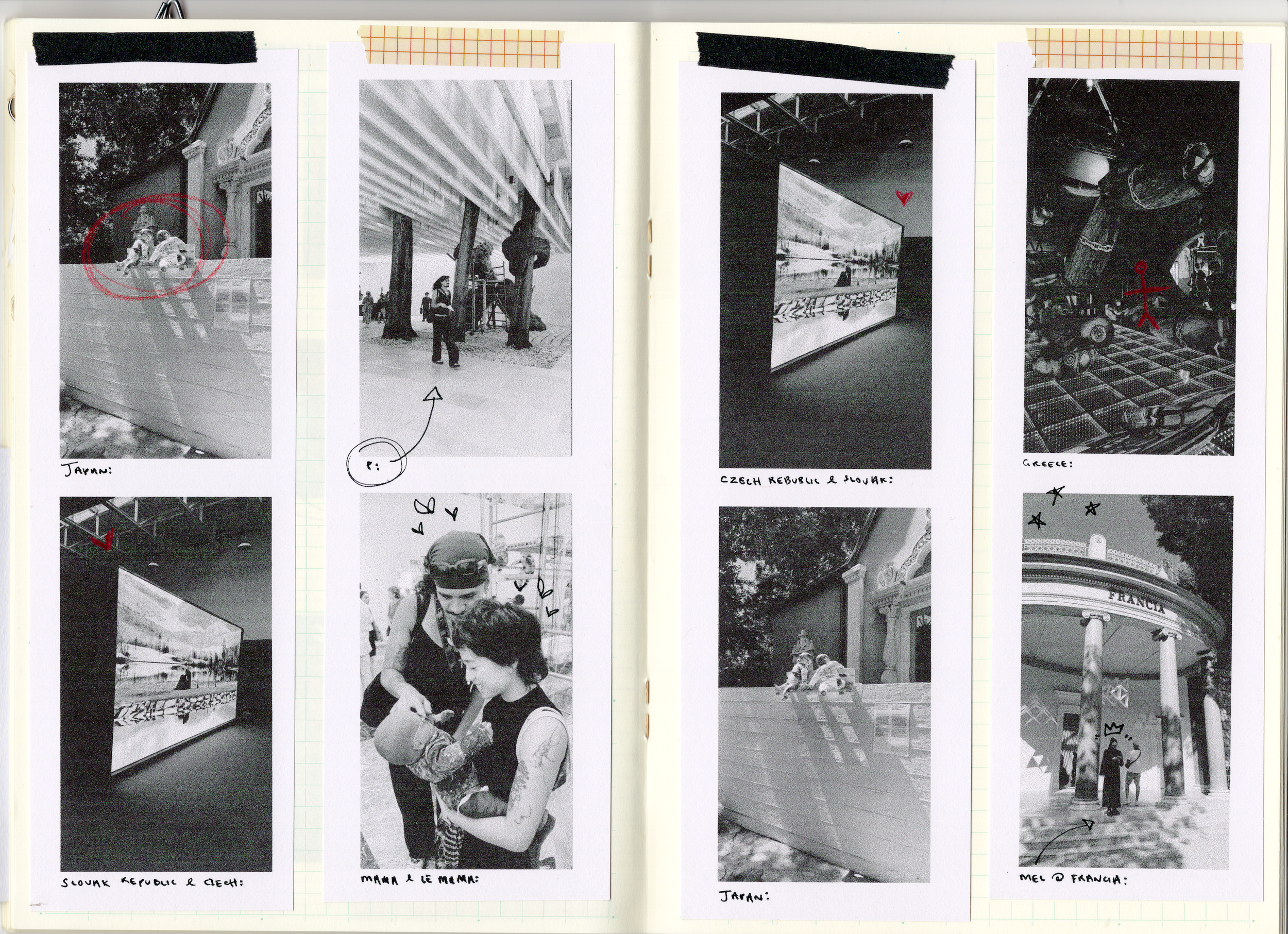
Journal page: B&W prints from Giardini
Looking through my journal later, I noticed how many of the works I had photographed that day were moving image works; animism sings anarchy, Li Yi-Fan’s Screen Melancholy, Gabrielle’s Elegy. I started mind mapping ideas for videos I might want to make myself, writing down fragments like “breath as a structure for film”, “the replica” and “motion / avatars as a type of costume”.
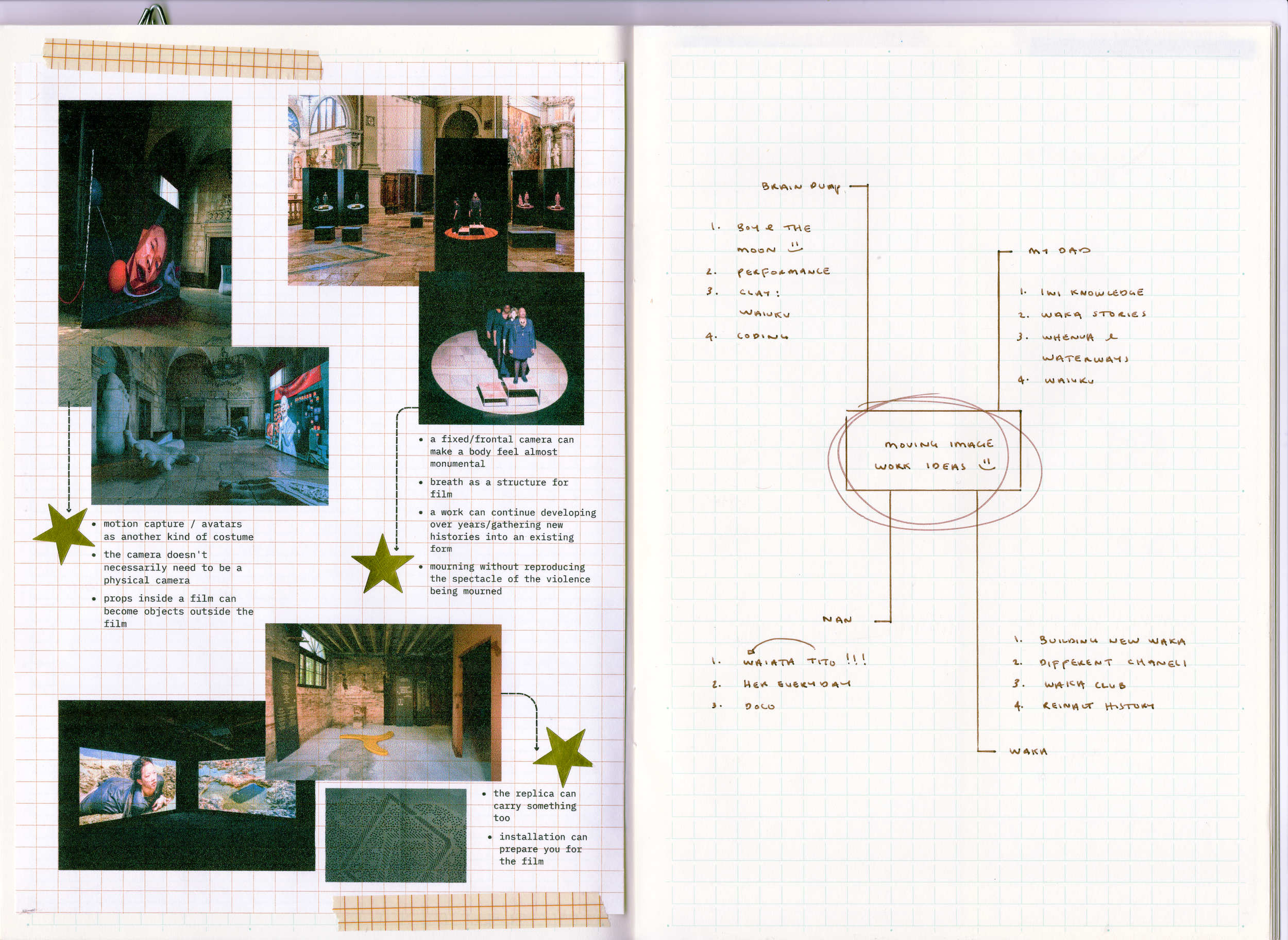
Journal page: Future art ideas
DAY 3
The 61st International Art Exhibition of La Biennale di Venezia was titled In Minor Keys by curator Koyo Kouoh. Kouoh passed away in May 2025, before the exhibition opened (poouri as), with the Biennale and her chosen team going on to realise the project she had already developed. A small excerpt from her curatorial text became a key point for us while Learning from Venice:
“...the time has come to listen to the minor keys, to tune in sotto voce to the whispers, to the lower frequencies; to find the oases, the islands, where the dignity of all living beings is safeguarded.”
With that in mind, I went into the day moving between the Giardini and the Arsenale, looking for the ‘minor key’ within the works.
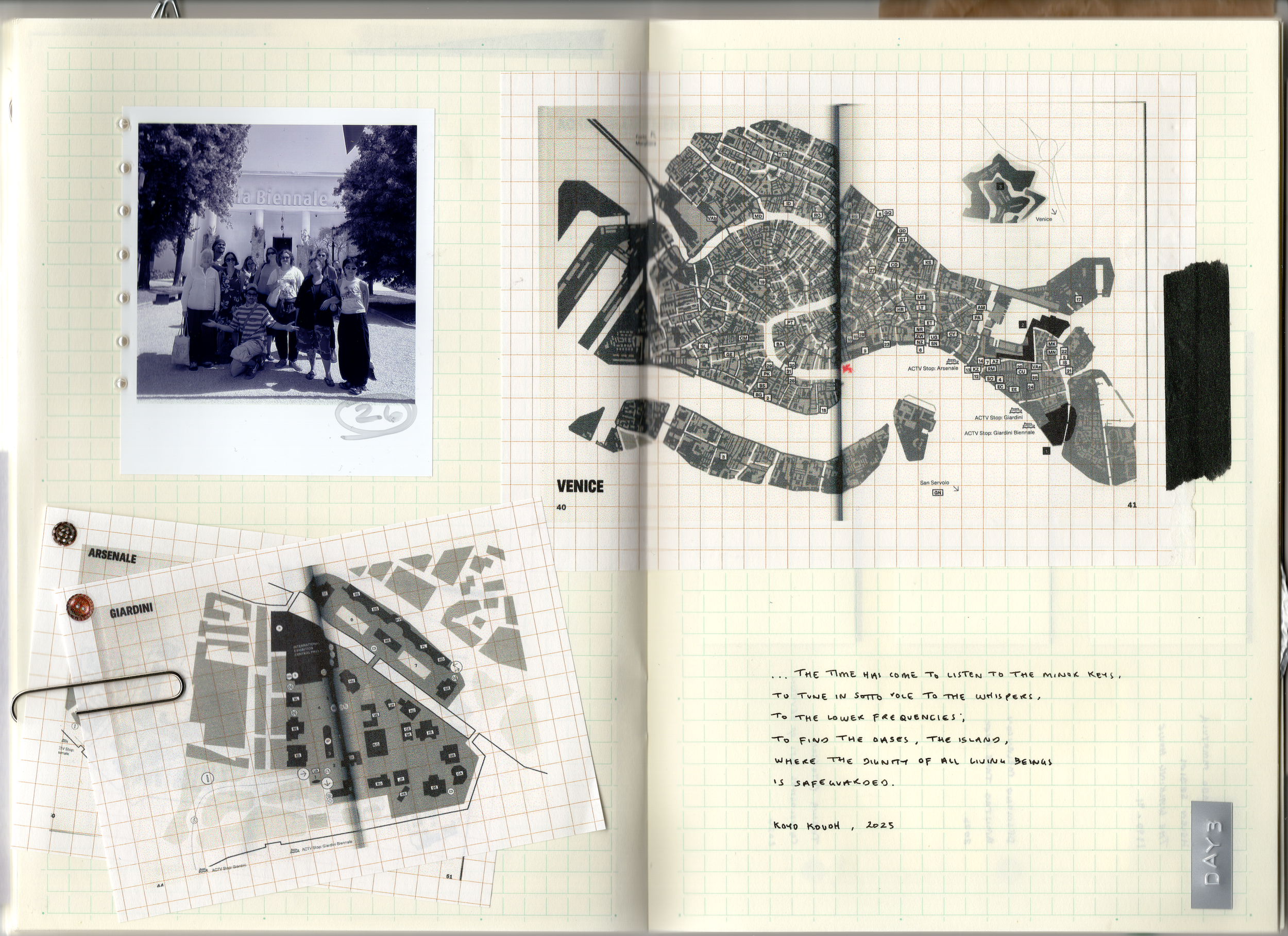
Journal page: Maps of Giardini, Arsenale and collateral presentations
At our morning hui we had talked about whether biennales develop an overarching aesthetic, something you can sense across an exhibition. With 110 invited participants across In Minor Keys, this became another lens I carried with me through the day. What is the overall aesthetic?
Moving through the Giardini and Arsenale, one of the first things I noticed was the ‘hand-made-ness’ of the works. So much of it felt tactile: textured surfaces, raw edges, stitching, things that had an almost unfinished quality to them. I found myself photographing details instead of whole works, zooming into tiny sections even when some of the works themselves stretched several metres in scale.
Journal page: Details of artworks from the Giardini
I also thought back to an exercise a past supervisor had shared with me for navigating an exhibition. The idea was to imagine a conceptual sticker sheet of gold stars: decide what each star is for, then work out which works you would give one to.
So I made my own imaginary sheet and started handing them out. A star could be for a work’s formal qualities, how it sat within the space, its concept, or just something I thought was really cool and wanted to keep looking at. I ended up giving out four.
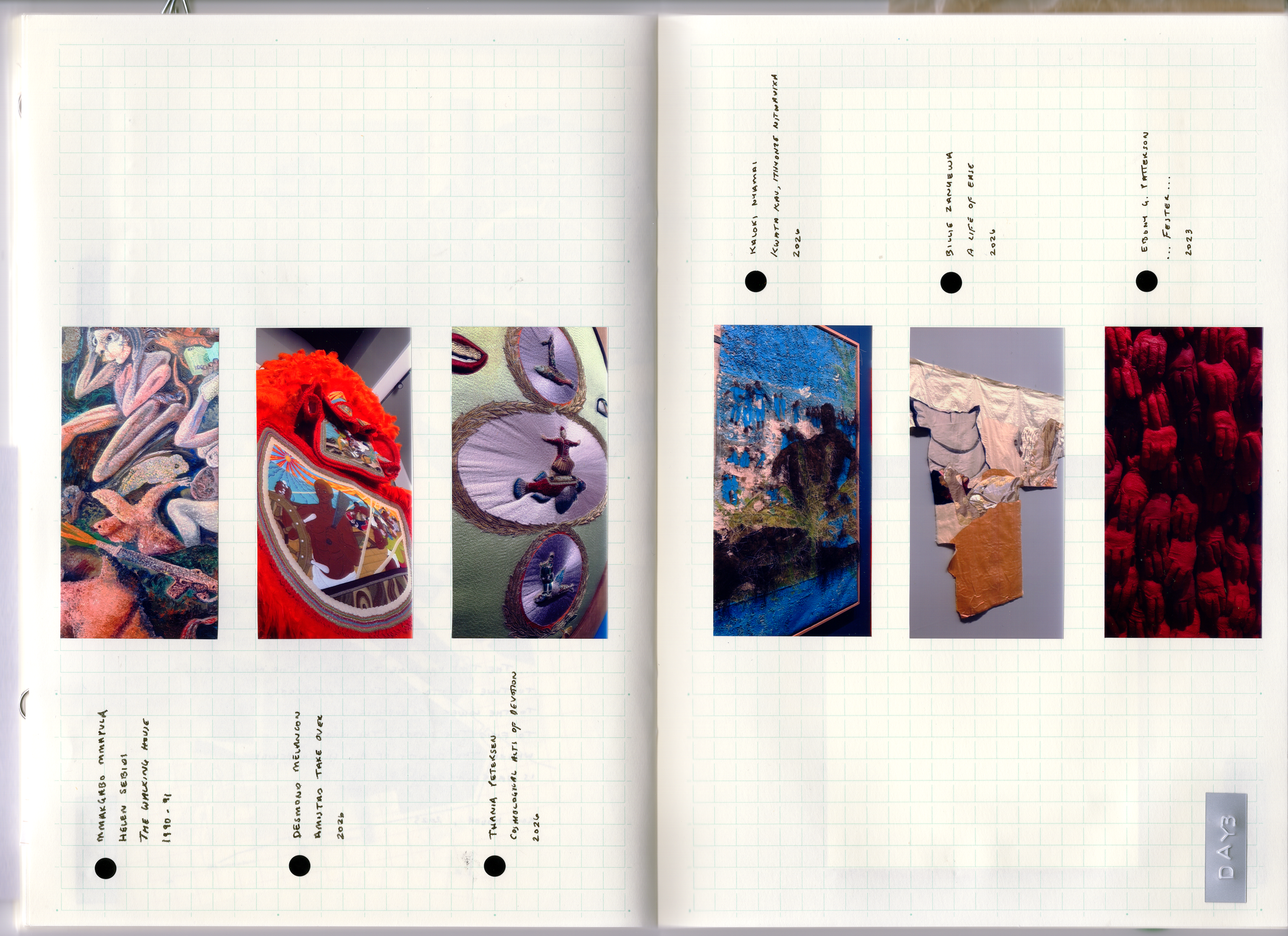
Journal page: Gold star works from the Giardini and Arsenale: Sabian Baumann, Edouard Duval-Carrié, Joana Hadjithomas + Khalil Joreige, Ayrson Heráclito
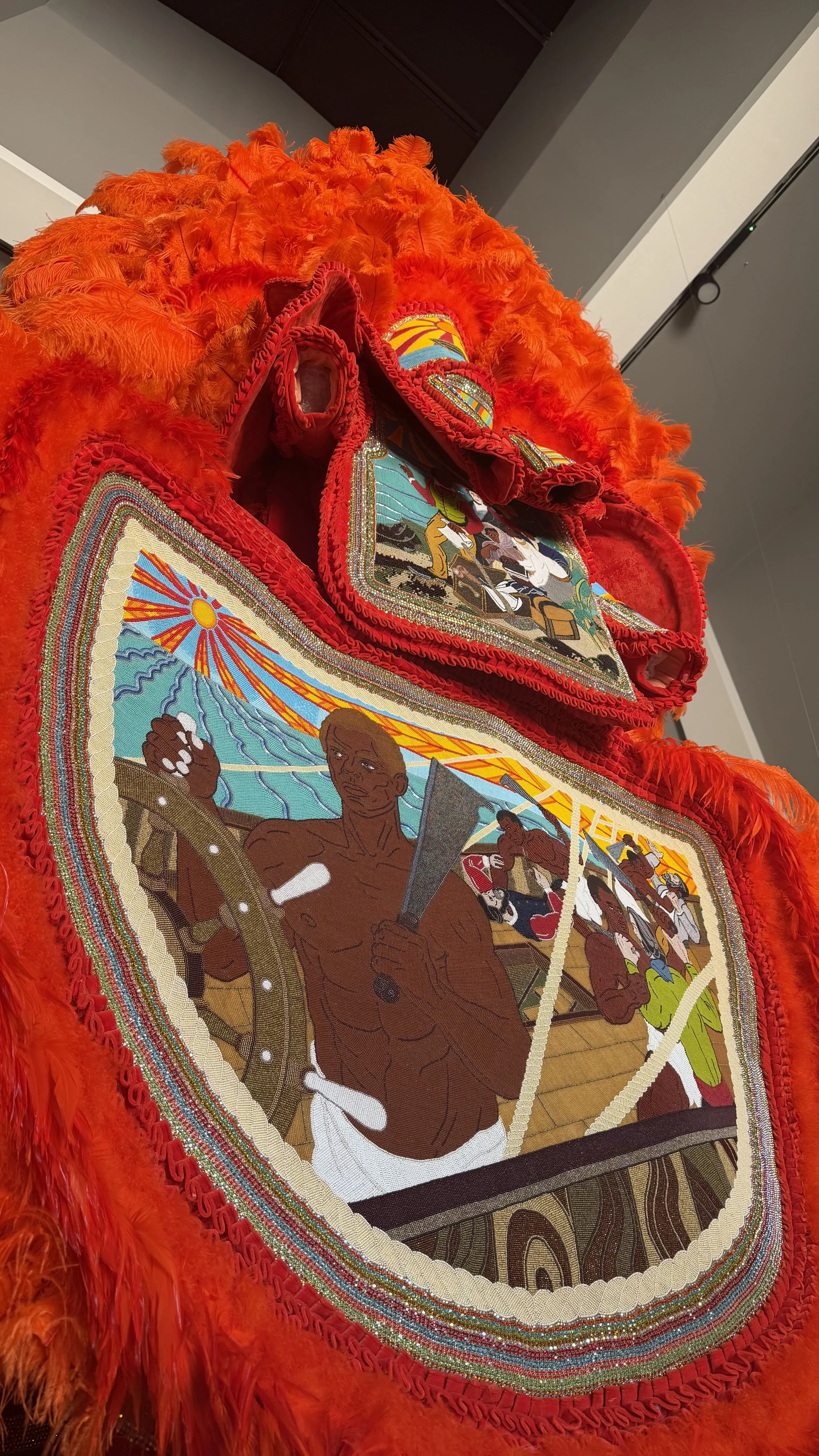
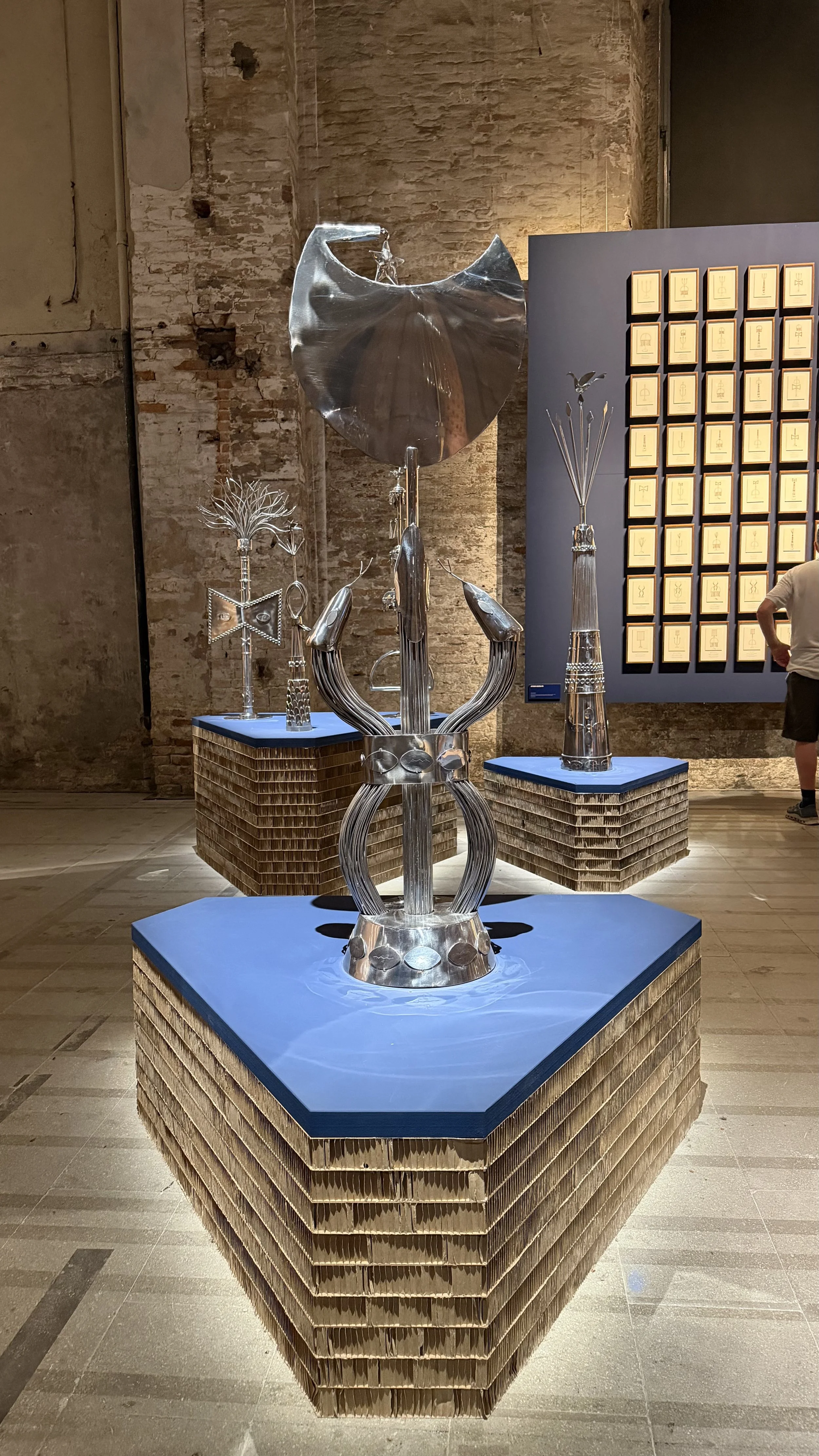
Above : Details of Demond Melancon’s Amistad Takeover (left) and Ayrson Heráclito’s Juntó (right).
After hours across both the Giardini and Arsenale, looking at more art than I think I had ever seen in one day, we stopped for kai at a beautiful restaurant, vibes immaculate. Aperol Spritz, pasta and tiramisu while the sun set around us.
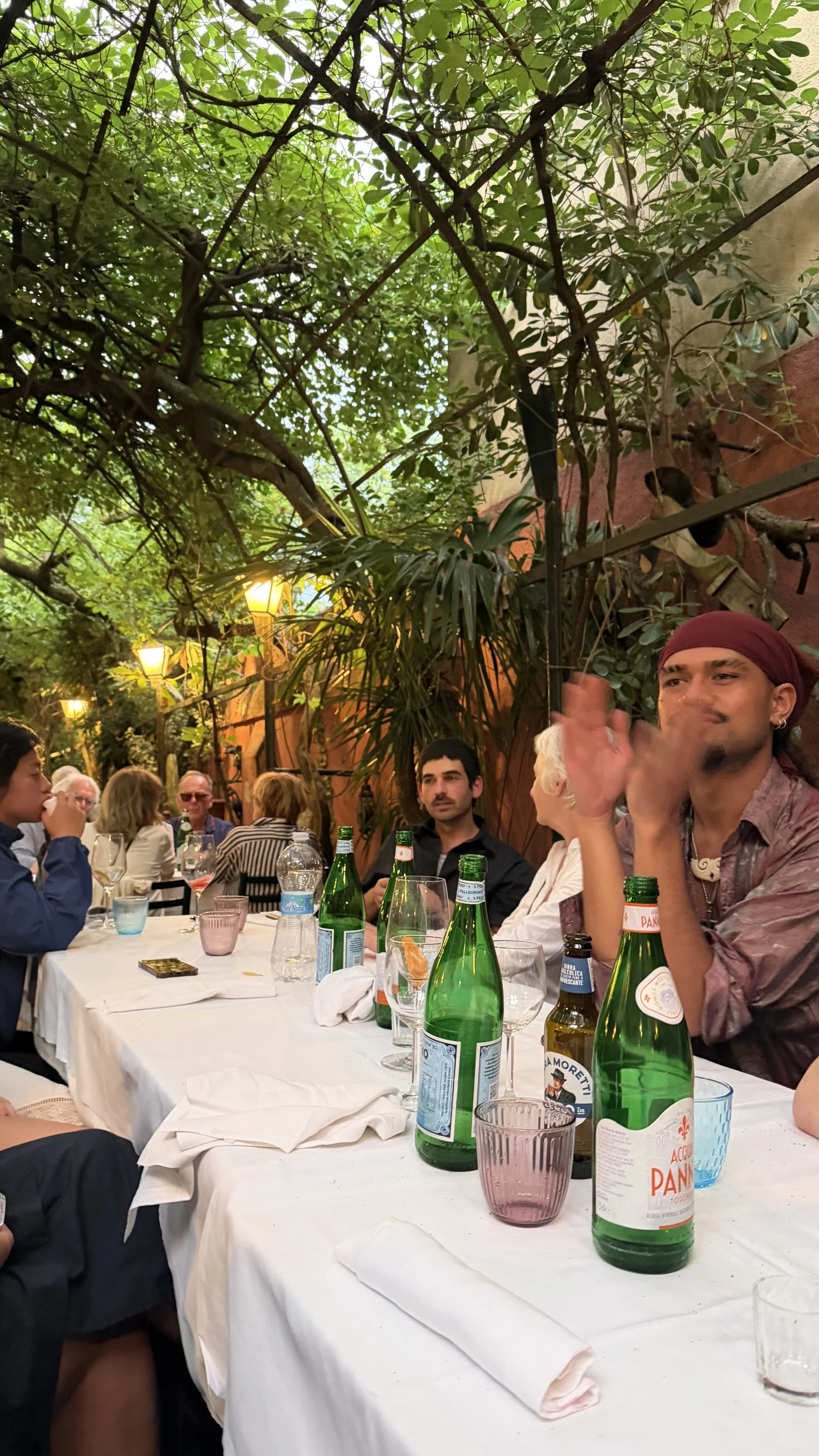
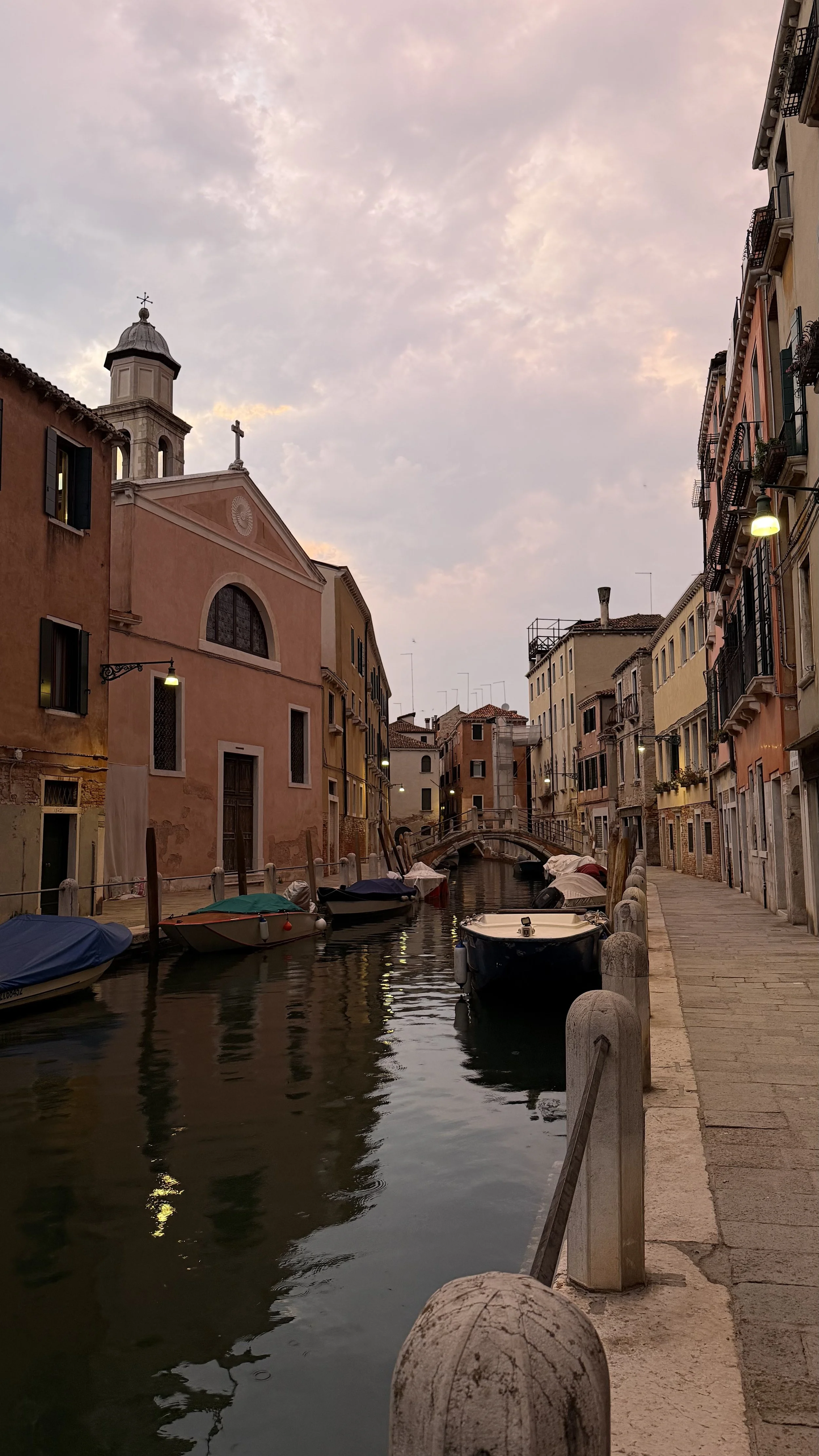
Kai at Antica Locanda Montin (left) and evening walk back through Venice (right).
DAY 4
Thursday took us back to the Arsenale, continuing through the national presentations we hadn't made it to the day before, including India's Geographies of Distance: Remembering Home.
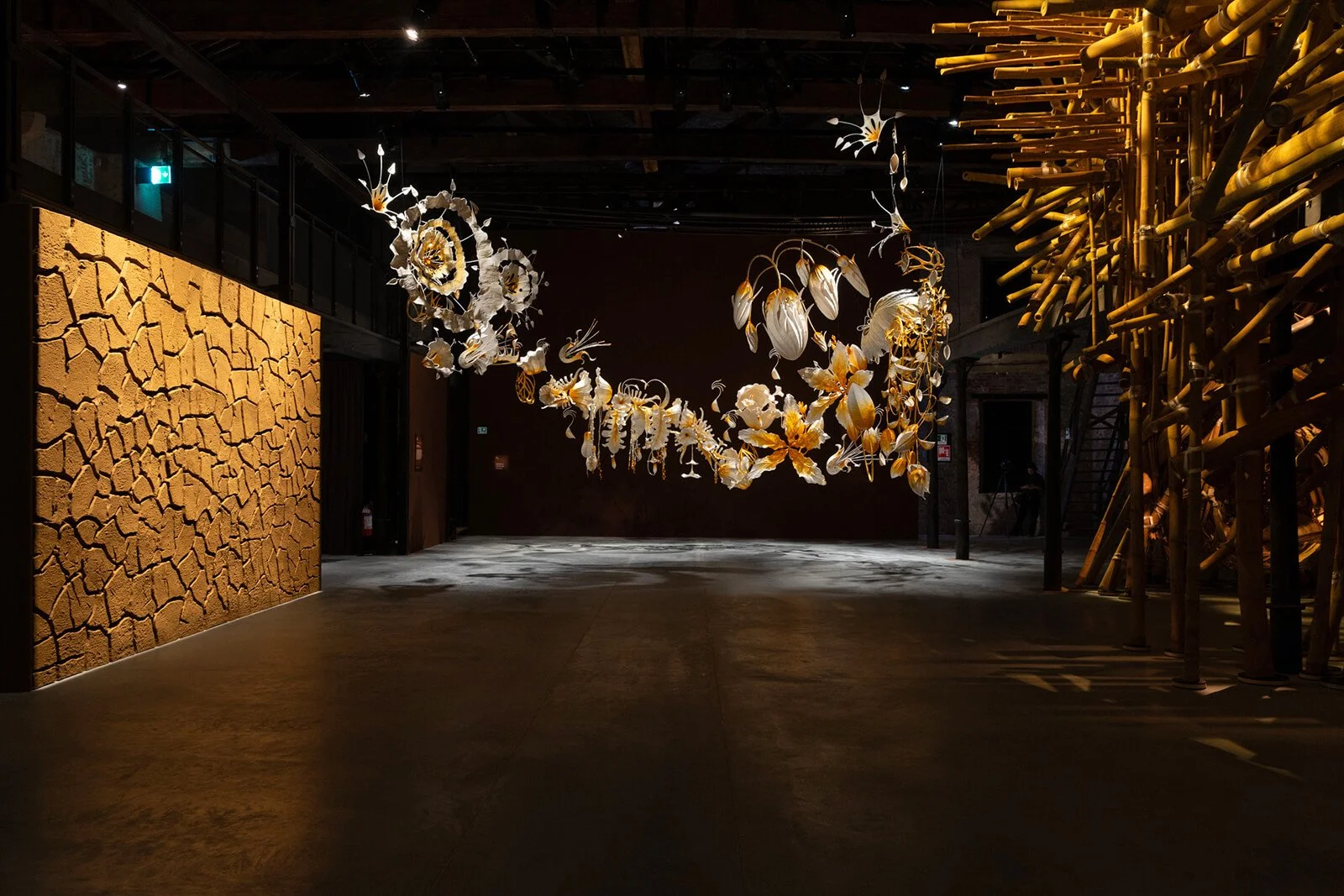
India, Geographies of Distance: Remembering Home
Photo: Luca Zambelli Bais. Courtesy of La Biennale di Venezia
There was something about the works that felt very tuupuna coded, almost ancestral to me. I was especially drawn to Sumakshi Singh’s reconstruction of a demolished family home, made in thread. I kept thinking about the act of reconstructing a home that no longer exists, almost as a way of paying homage to it, to everything it held and the generations of whaanau who once lived there.
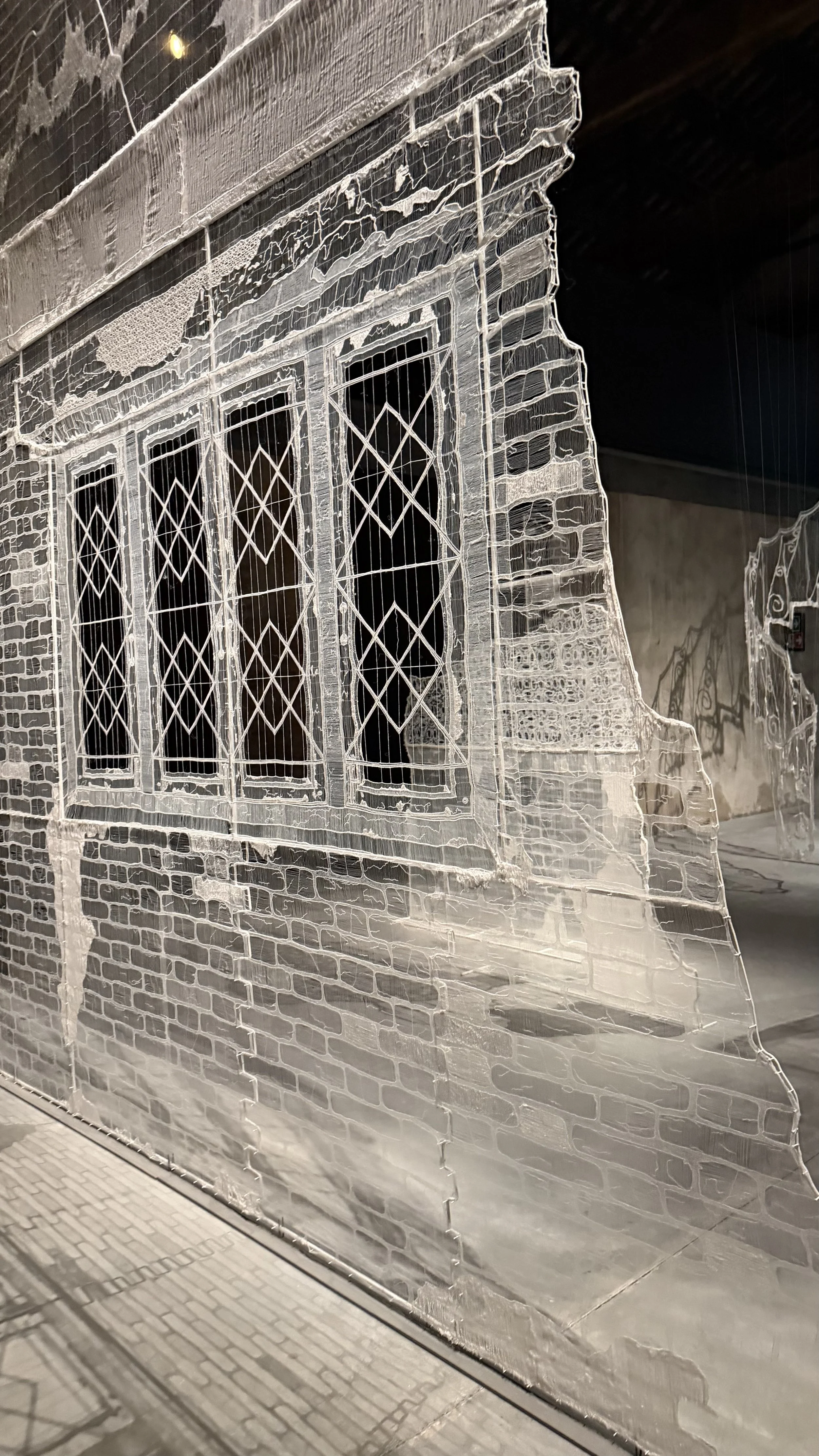
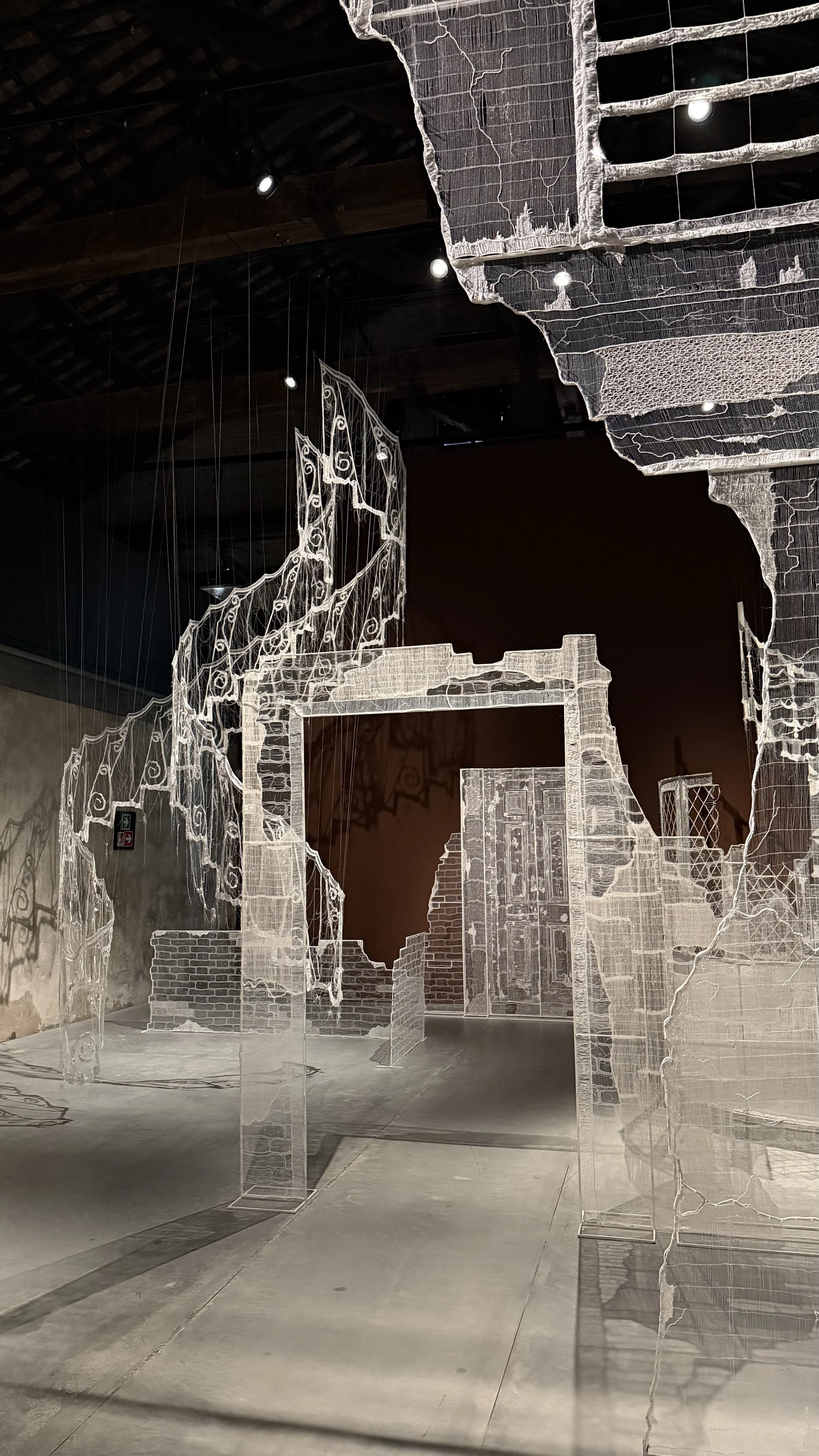
India, Sumakshi Singh’s Permanent Address
Later, we went to the Holy See Pavilion, The Ear Is the Eye of the Soul, which was split across two sites. We began at the Giardino Mistico dei Carmelitani Scalzi, a monastic garden where sound works were experienced through headphones as we moved through the space.
The first thing I noticed when I walked into the garden was the hydrangeas, the same flowers that grew at the entrance of my nan’s driveway. Standing beside them, the sound in my headphones made me think of stars. Like twinkly stars during the daytime, if you could see them! The garden smelled warm. I’m not really sure what warmth smells like, but that’s what comes to mind when I think about it lol.
As we moved through the garden, the sound changed depending on where we were and what we walked beside. There was one corner I particularly liked, with a bench along the side where I sat and journaled for quite a while. A lot of what I wrote in my journal became about my nan, about being Maori and about being away from home.
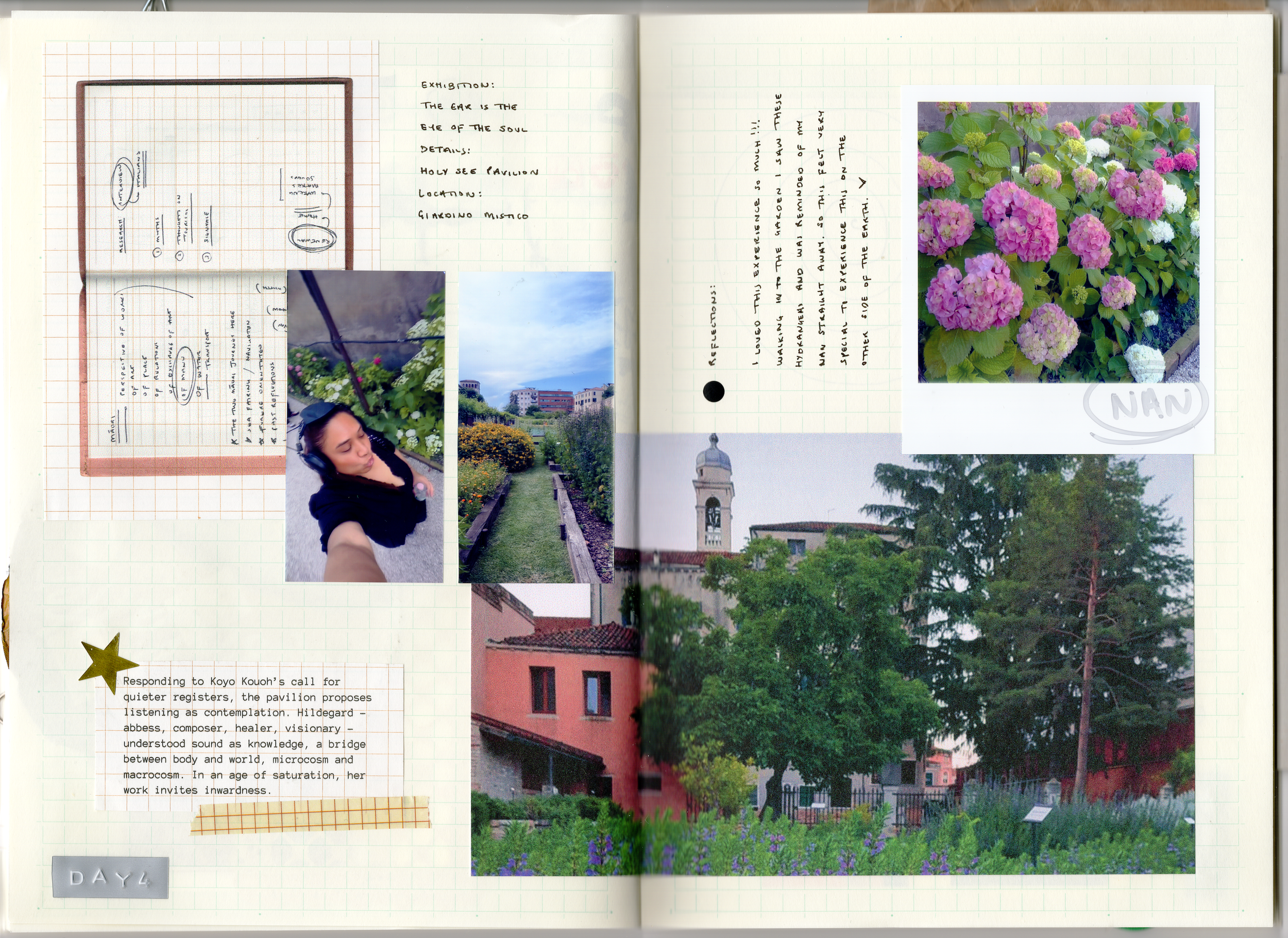
Journal page: Holy See Pavilion, Giardino Mistico dei Carmelitani Scalzi
We then went to the second half of The Ear Is the Eye of the Soul at the Complesso di Santa Maria Ausiliatrice. Here, the pavilion shifted into what it described as a contemporary scriptorium and living archive, with books, sound, moving image and archival material spread throughout the rooms.
I became really interested in the mechanics of how the exhibition had been put together. I started thinking about the relationship between the different parts of a show, and noted down the idea of one day approaching an exhibition through a similar front room / back room structure.
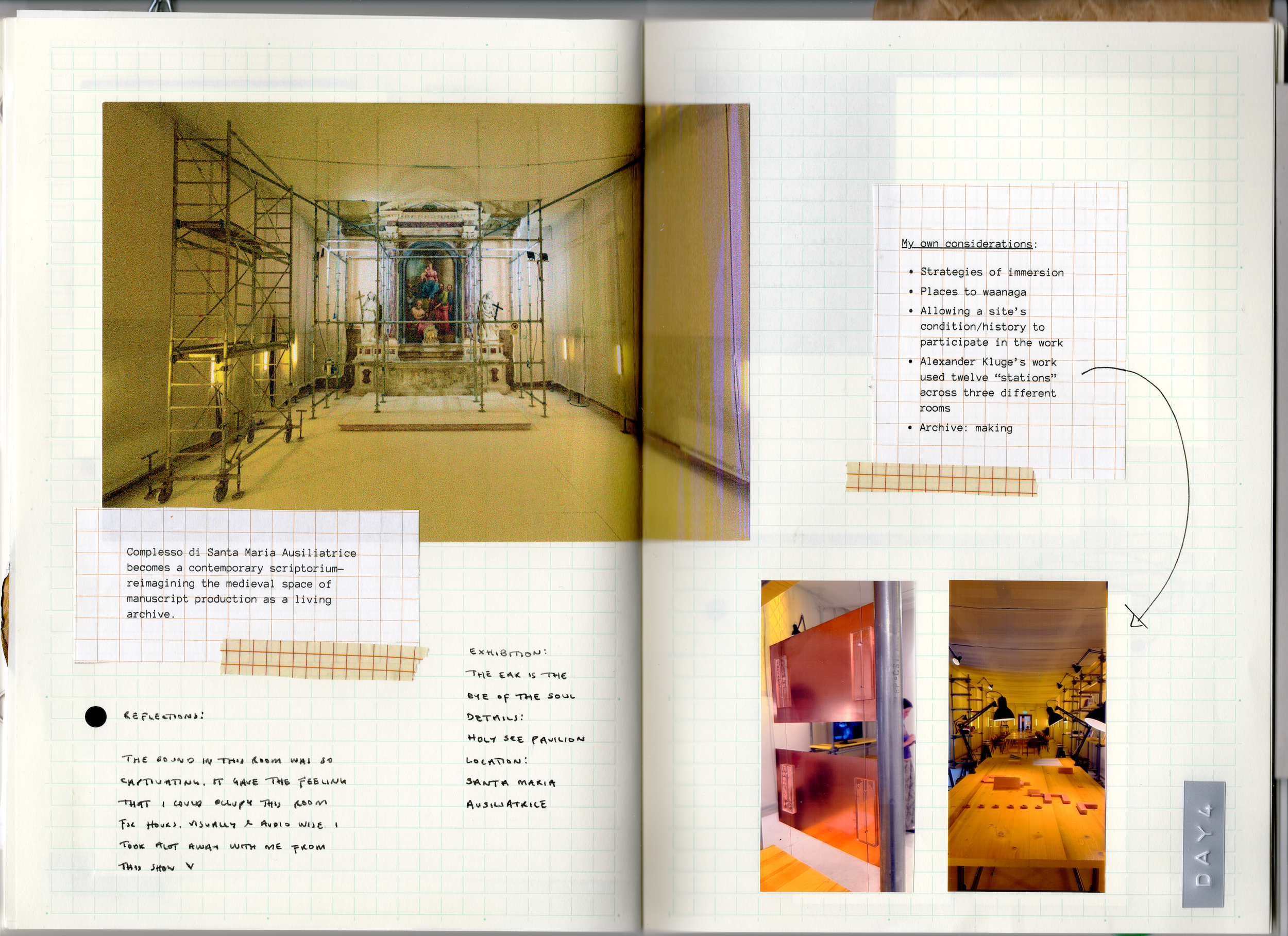
Journal page: Holy See Pavilion, Complesso di Santa Maria Ausiliatrice
We ended the day with kai. I had gnocchi that somehow tasted like corned beef and loved it so much! Then we caught the vaporetto home, ready for our last day of the programme.
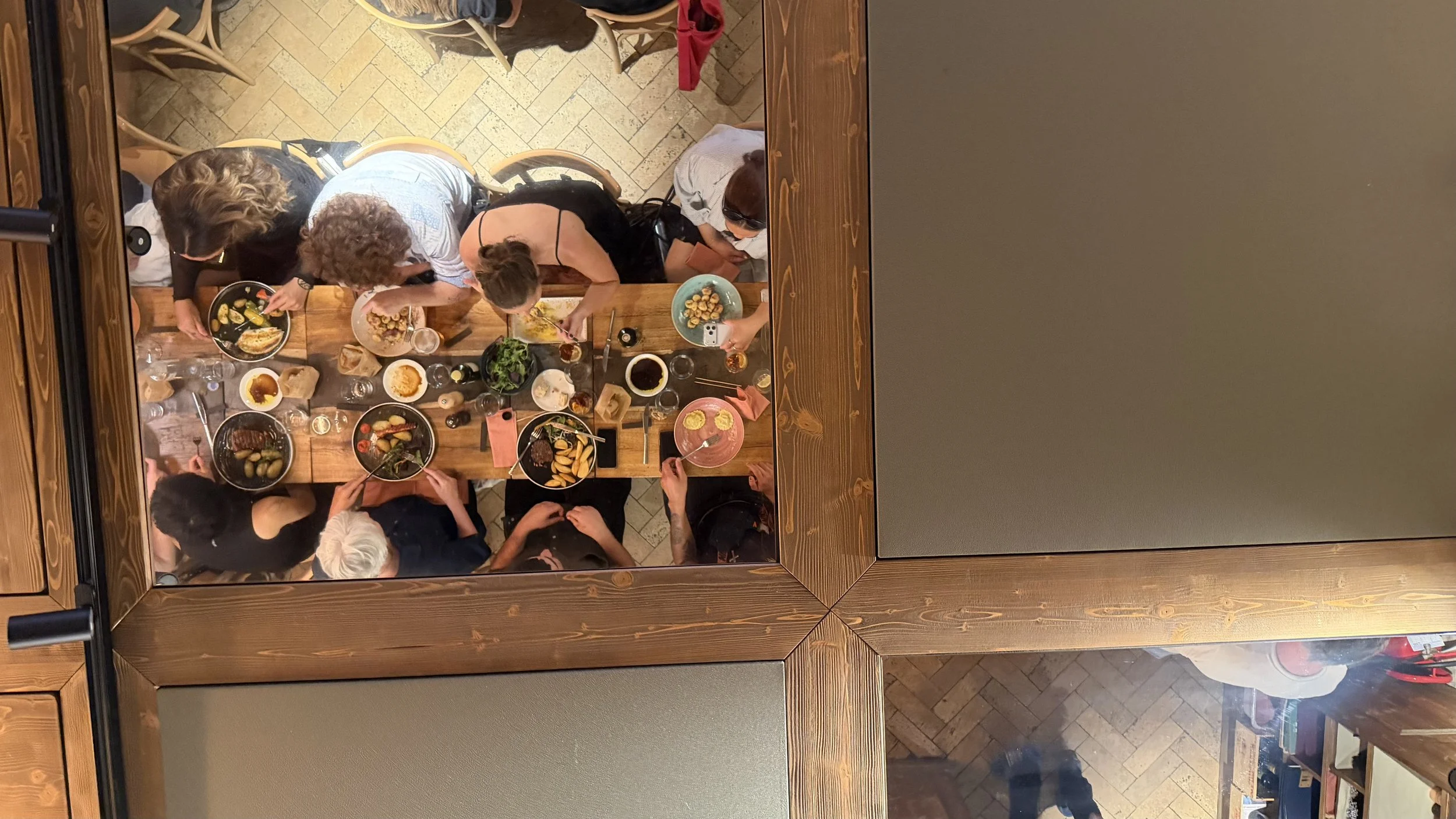
Table view at dinner
DAY 5
I was so happy with the amount of ephemera I had collected over the week: pamphlets, maps, cards and exhibition booklets. With it being our last day, the only problem was figuring out how I was going to get all of it home.
We caught the vaporetto across to Giudecca to visit Kereama Taepa’s Pouhono at CREA. Made for Paerangi: Venice, the 3D-printed pou whenua holds four atua across its sides. Hinemoana and Tangaroa face towards the lagoon and out to the ocean, while Te Uira and Hineteiwaiwa face back towards Venice.
From there we visited the Convent Garden of the Church of the Most Holy Redeemer, also on Giudecca. Under a canopy of leaves, I spent some time drawing. I kept returning to images of above and below, inside and outside, opposites that could exist within the same image.
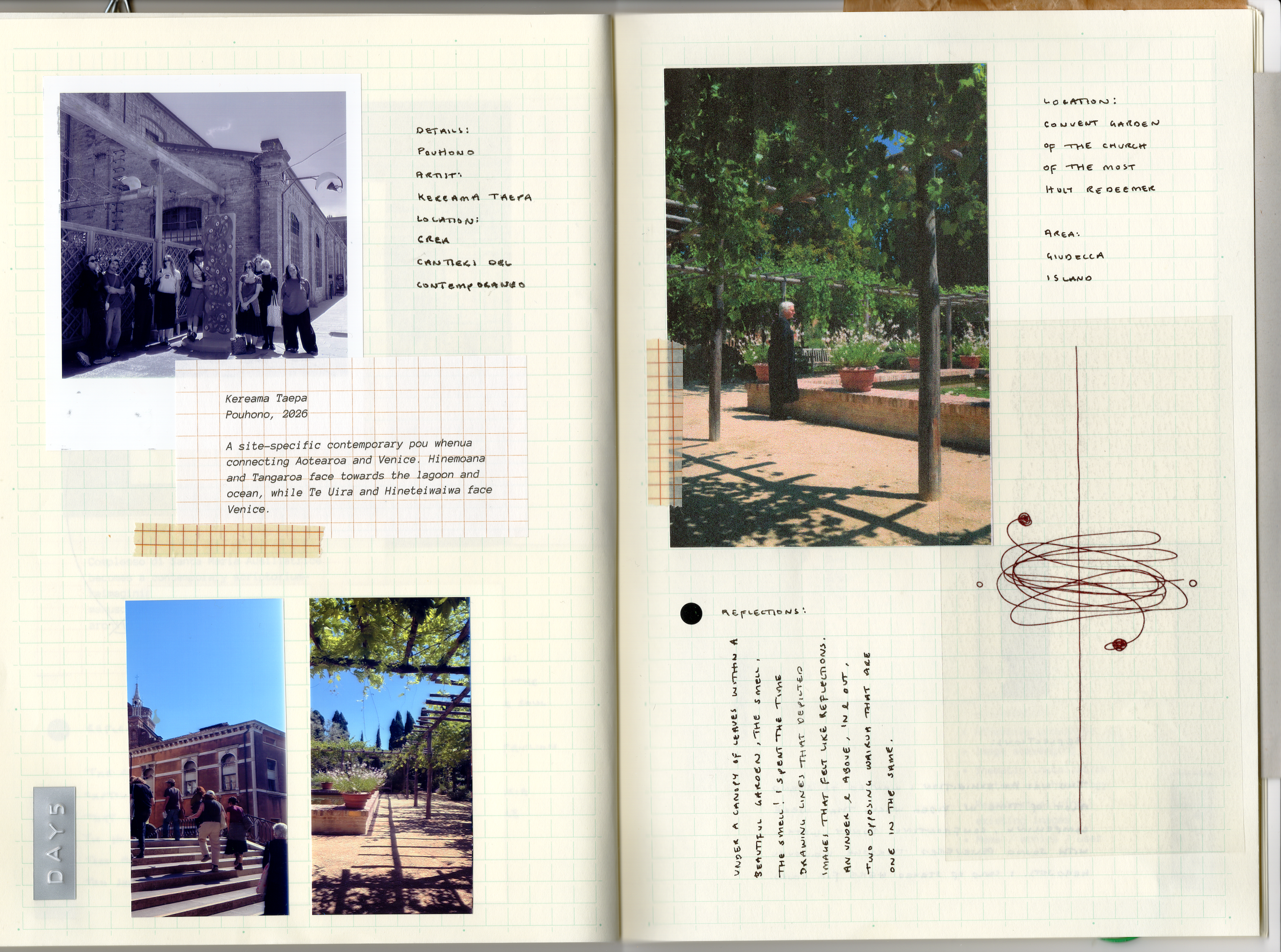
Journal page: Kereama Taepa’s Pouhono, Convent Garden of the Church of the Most Holy Redeemer
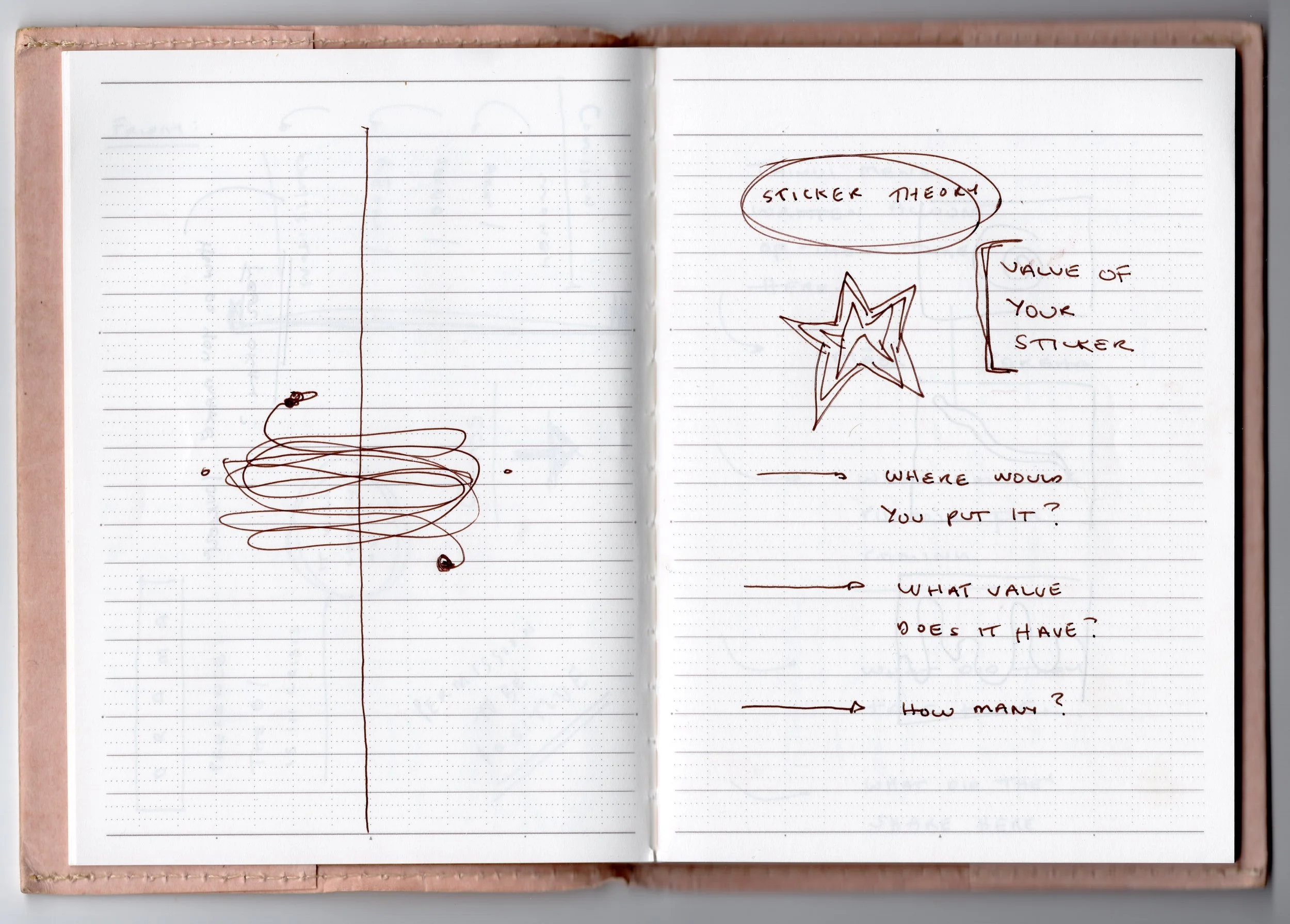
Journal page: Drawings and reflections
One of the last exhibitions we visited was Helter Skelter: Arthur Jafa and Richard Prince at Fondazione Prada. I could have stayed there for hours. I remember moving from room to room, watching the video works, laughing, cringing.
The exhibition paired Jafa and Prince through their shared use of images pulled from all over popular and visual culture. Two things I wrote down in my journal were “image scavenging” and “affective proximity”. Jafa credits the latter to John Akomfrah: the idea that placing images with their own emotional charge beside one another can create something new through their proximity. It made sense of why I found the show so intoxicating? The images kept colliding with each other, pulling out completely different emotions as they went.
I’m grateful this was one of the last exhibitions we experienced together during the programme.
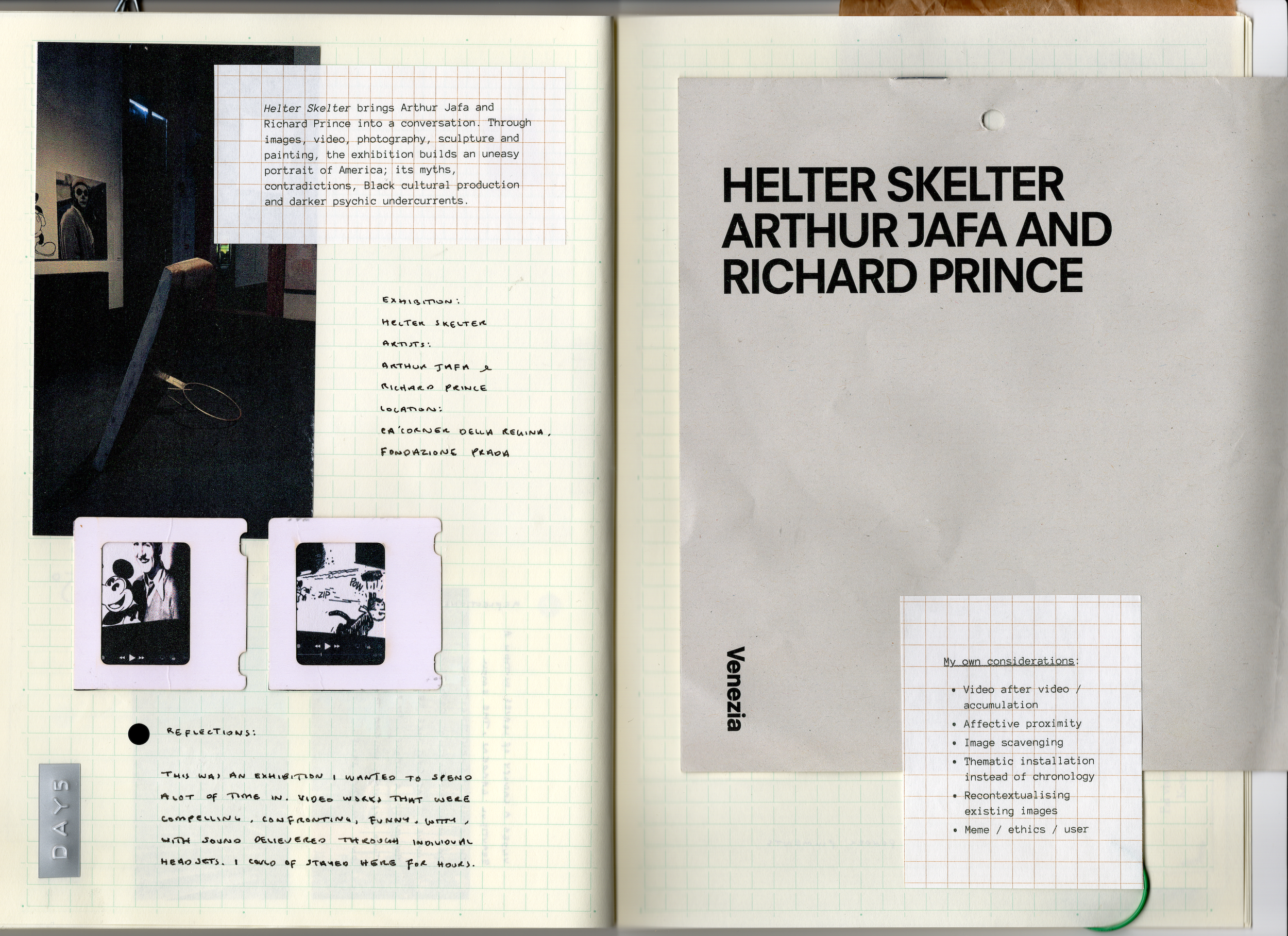
Journal page: Helter Skelter: Arthur Jafa and Richard Prince
We had some spare time afterwards, so a group of us went off and did some very necessary tourist stuff. Fridge magnets, VENEZIA bedazzled hats. I had been wanting to visit an art store all week and finally made it in, buying pigments that I could use with water, oil or acrylic.
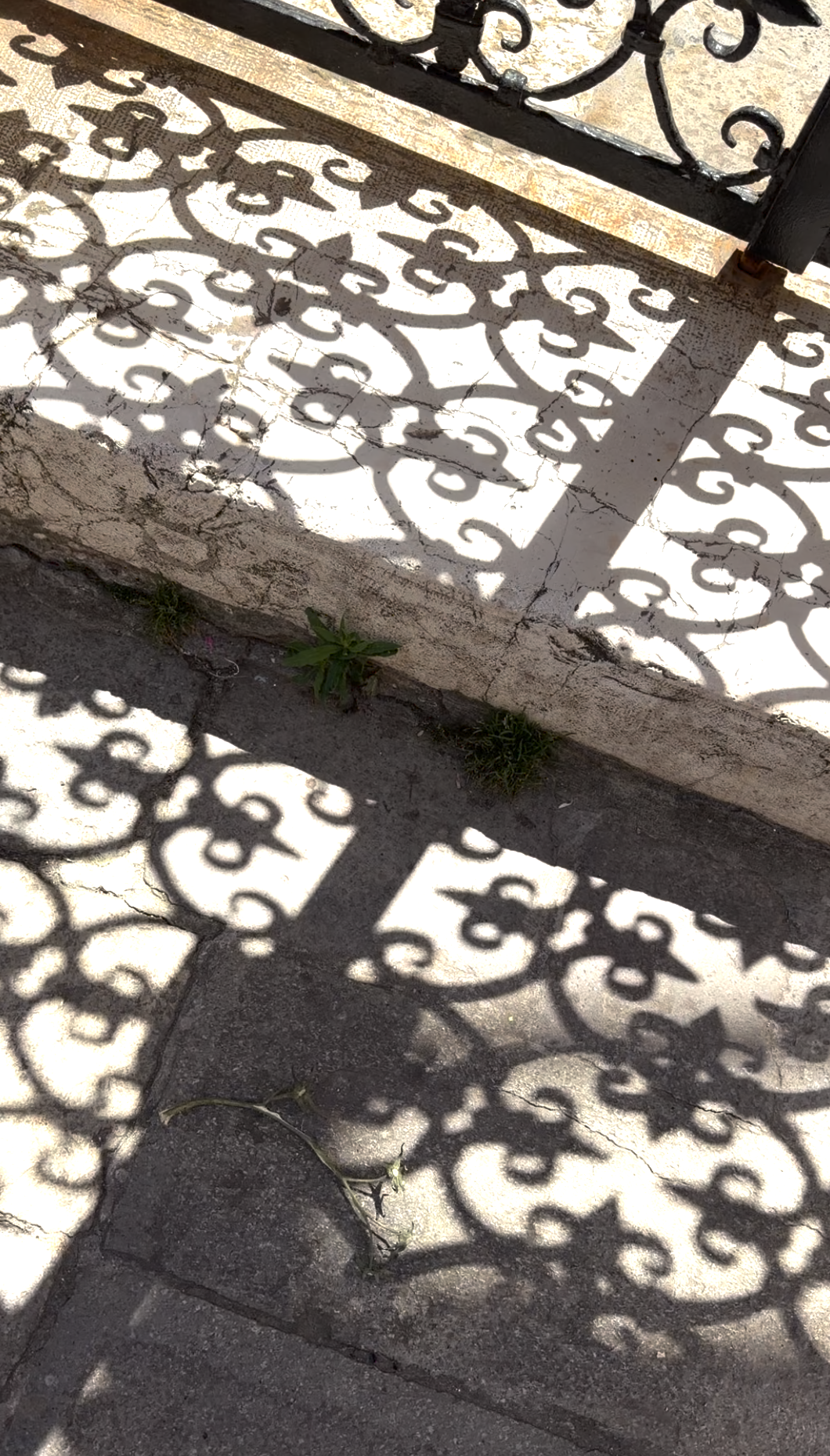
We also stopped at Il Pavone Stamperia, where I had a custom stamp made. It made me think again about all of the ornamental details I had been noticing across Venice, worked into gates, doors, windows and pavements. History evidenced all around us.
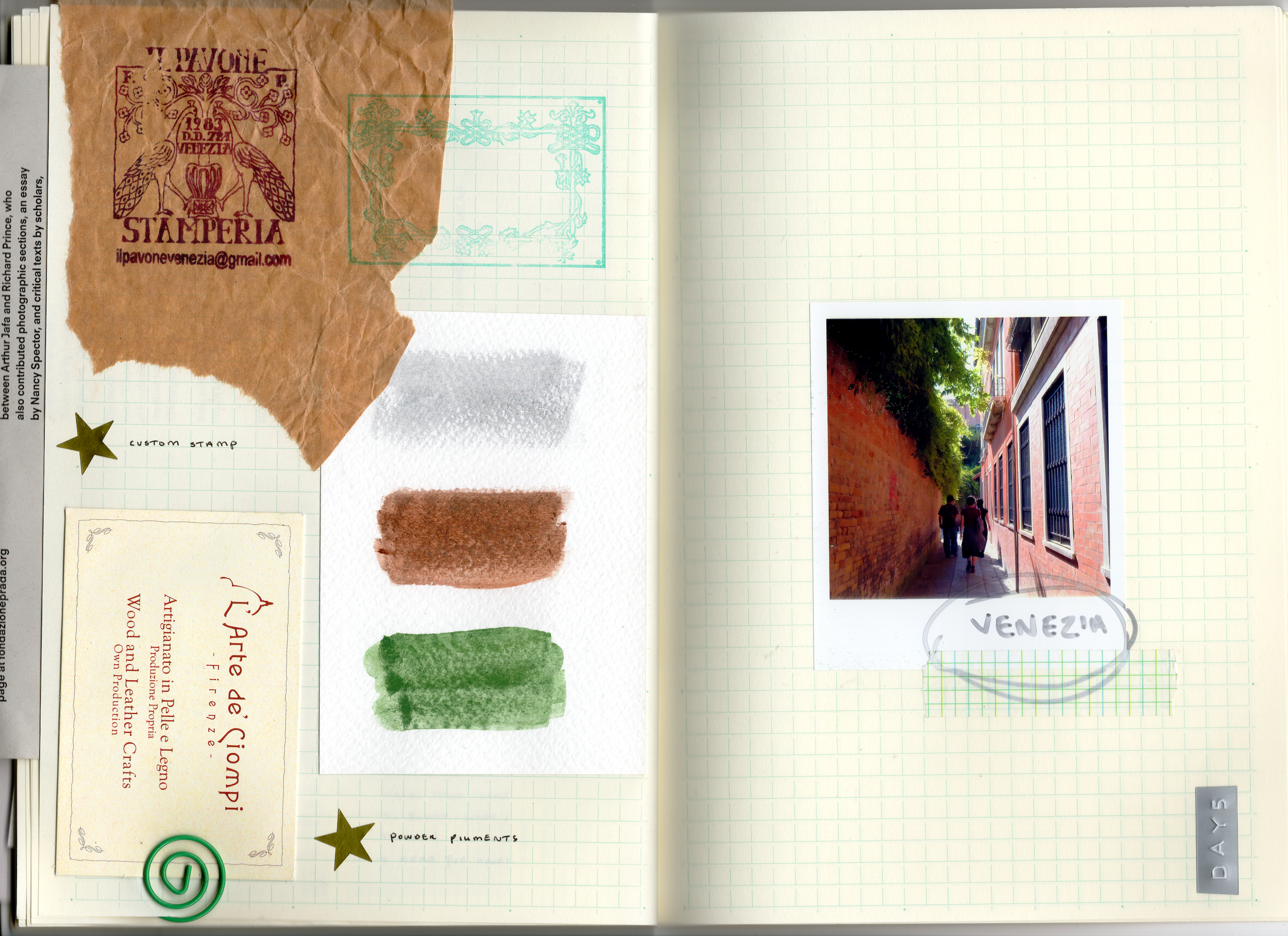
Journal page: Venezia ephemera, pigments and custom stamp
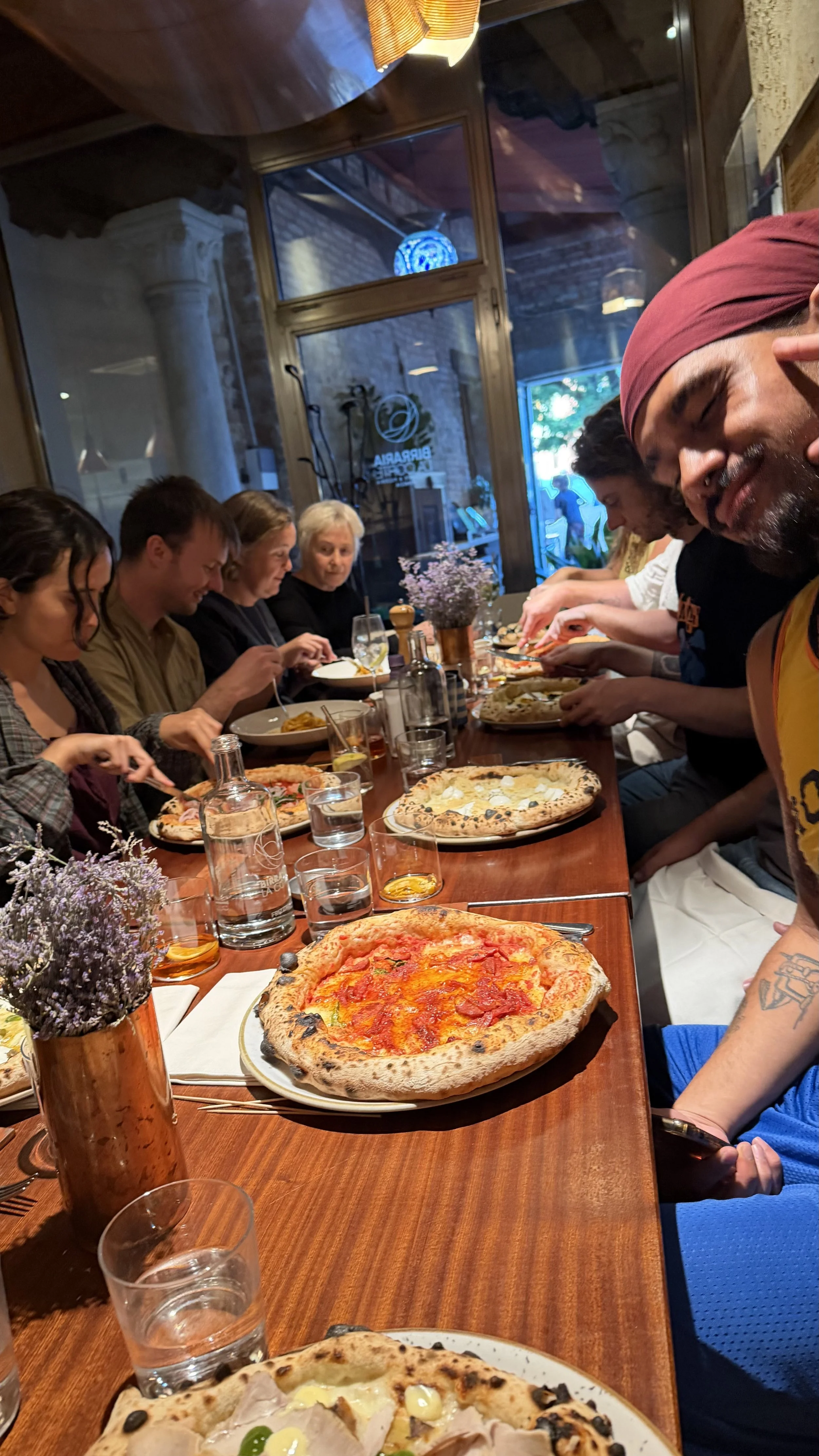
We then ended the programme with a poroporoaki, a closing debrief and, of course, pizza.